



























New Delhi, Apr 10 (APAC Media): Prime Minister Narendra Modi is set to inaugurate the Delhi–Dehradun Expressway on April 14, marking a major milestone in India’s highway infrastructure development, according to official and media reports
The 210-km access-controlled corridor, also known as the Delhi–Saharanpur–Dehradun Expressway (Delhi–Dehradun Expressway), has been developed by the National Highways Authority of India (National Highways Authority of India) at an estimated cost of about Rs 12,000 crore. The project links Delhi with Uttarakhand’s capital Dehradun, significantly enhancing regional connectivity across Delhi, Uttar Pradesh and Uttarakhand.
According to reports, the expressway is expected to cut travel time between Delhi and Dehradun from over six hours to around 2.5 hours.
The route passes through key urban and semi-urban centres, including Baghpat, Shamli and Saharanpur, along with adjoining areas, and features multiple interchanges and service facilities designed to improve traffic movement and ease congestion on long-distance routes.
However, the National Highways Authority of India, in collaboration with the Wildlife Institute of India, has released a detailed report titled “Landscapes Reconnected” highlighting the effectiveness of wildlife mitigation measures along the Delhi–Dehradun Economic Corridor.
Prime Minister Narendra Modi will inaugurate the Delhi–Dehradun Expressway on April 14 in Uttar Pradesh, officials said. The project is expected to enhance tourism, trade and pilgrimage connectivity in Uttarakhand, particularly improving access to key destinations such as Haridwar and the Char Dham circuit.
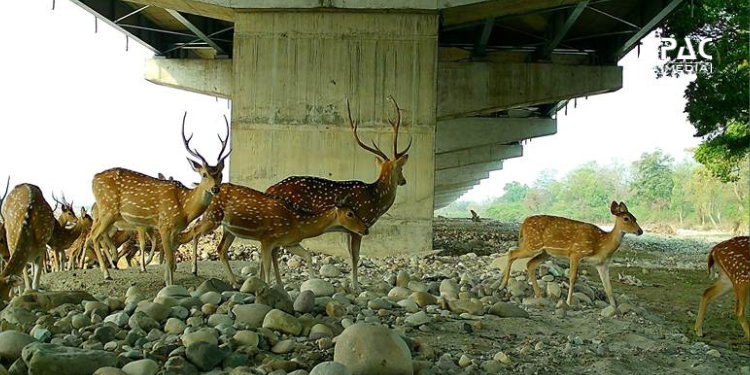
The study provides the first empirical evidence of wildlife successfully using engineered underpasses in the ecologically sensitive Shivalik landscape.
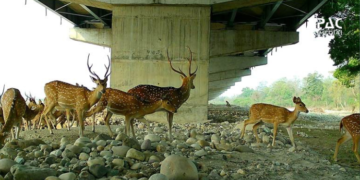
The assessment was conducted along an 18-km stretch of the Ganeshpur–Asharodi section (Ganeshpur–Asharodi section), where a network of 10.97 km-long animal underpasses and elevated structures has been constructed to ensure unhindered animal movement.
The forested corridor, located in the Shivalik range (Shivalik range), is known habitat for species such as elephants, tigers, leopards, and king cobras. The study documented approximately 40,444 images of 18 unique wild species using the wildlife passages.
According to the report, the monitoring exercise deployed 150 camera traps and 29 AudioMoth acoustic recorders over a 40-day period, generating more than 111,000 images. Golden jackals were the most frequently recorded species, followed by nilgai, sambar, and spotted deer.
In an official statement, the National Highways Authority of India said modern highway infrastructure and ecological conservation can coexist through science-based planning and innovative engineering solutions. It added that ongoing monitoring, adaptive management and noise reduction measures will further strengthen wildlife crossings and help reduce human–wildlife conflict in the region.
Officials further stated that the expressway will play a key role in regional economic development by improving logistics efficiency and supporting faster movement of goods and passengers across the National Capital Region and adjoining hill states.
With its completion, the Delhi–Dehradun Expressway is being positioned as one of the flagship infrastructure projects under India’s expanding national highway network.



















Discussion about this post