


























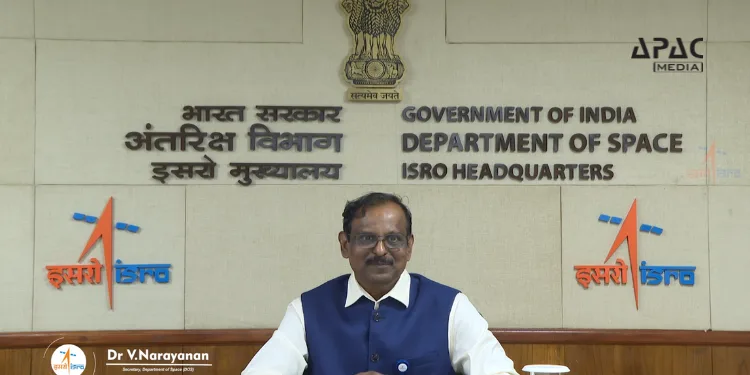
Bengaluru: The Indian Space Research Organisation (ISRO) will launch its next heavy-lift mission, LVM-3, on 2 November, to place the CMS-03 communication satellite (GSAT-7R) into orbit, ISRO Chairman and Department of Space Secretary V Narayanan announced.
The satellite, designed to enhance secure communication capabilities for strategic purposes, will lift off from the Satish Dhawan Space Centre, Sriharikota, marking another milestone in India’s expanding space operations.
Narayanan said the next few months will be packed with “many exciting missions,” highlighting the upcoming NASA-ISRO Synthetic Aperture Radar (NISAR) mission, which is set to become operational within the next two to three weeks.
Describing NISAR as a “major milestone in Indo-US space cooperation,” he confirmed that the satellite remains in good health and both payloads are functioning optimally.
Following CMS-03, ISRO plans another LVM-3 launch in early December to carry BlueBird, a private US communication satellite.
Narayanan also provided updates on key lunar and human spaceflight missions, including Chandrayaan-4, Chandrayaan-5 and the Indo-Japanese LUPEX project, emphasising that ISRO is steadily advancing toward landing Indian astronauts on the Moon and bringing them back safely.
A next-generation heavy-lift launcher capable of carrying 70-80 tonnes to low-Earth orbit is under development for that goal.
On the Gaganyaan human spaceflight programme, Narayanan said that 90 per cent of the required technologies have been developed and ISRO will conduct three uncrewed test missions before attempting the first crewed launch, likely by 2027.
He also confirmed government approval for a third launch pad at Sriharikota, with an investment of over Rs 4,000 crore and said ISRO is progressing on its semi-cryogenic engine and the Bharat Space Station, targeted for initial orbital deployment by 2028.
India currently operates 56 satellites for civilian and strategic purposes, a number expected to triple within four years, Narayanan said. The NavIC navigation network will be expanded with three additional satellites over the next 18 months. Praising the 2020 space sector reforms, Narayanan credited them for the rise of over 300 space startups, calling it a sign of India’s “inclusive and fast-growing” space ecosystem.
Also Read –
ISRO Deploys Schneider Electric Automation Tech at Sriharikota for Launch Missions





















Discussion about this post