




























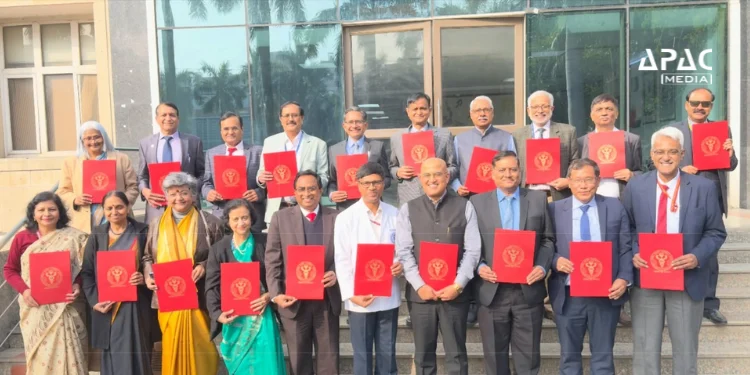
New Delhi: The All India Institute of Medical Sciences (AIIMS), New Delhi, signed a Memorandum of Understanding (MoU) to create a pan-India collaborative framework aimed at strengthening biomedical and clinical research across the country.
The agreement was formalised on AIIMS Research Day 2026.
The MoU seeks to promote joint research projects, multi-institutional studies, clinical trials, researcher exchange programmes, and systematic sharing of knowledge and best practices across the AIIMS network. It is expected to enable closer coordination among institutions and improve the overall quality and impact of research outcomes.
20 AIIMS institutions are participating in the collaboration, which includes those located in New Delhi, Bathinda, Bhopal, Bhubaneswar, Bibinagar, Bilaspur, Deoghar, Gorakhpur, Guwahati, Jammu, Jodhpur, Kalyani, Madurai, Mangalagiri, Nagpur, Patna, Raebareli, Raipur, Rajkot, and Rishikesh.
AIIMS Delhi Director Prof. M. Srinivas said the creation of the collaborative research consortium reflects a shared commitment to advancing high-quality and nationally relevant research. He noted that pooling the strengths of AIIMS institutions across India would help generate strong scientific evidence, promote innovation, and support informed decision-making in healthcare. He added that the platform is expected to evolve as a key driver of collaborative research in the coming years.
The research agenda under the consortium will also focus on emerging and priority areas such as artificial intelligence in healthcare, affordable cancer therapies, healthcare-associated infections, and metabolic disorders.
As part of the agreement, each participating institution will nominate nodal officers and designate single points of contact to ensure effective coordination and smooth implementation of collaborative activities.
Dean (Research) at AIIMS Delhi, Prof. Nikhil Tandon, said the consortium provides a structured mechanism to undertake large, multi-institutional studies needed to address complex health challenges. He explained that harmonised research protocols, shared expertise, and access to diverse patient populations would improve research quality, enhance reproducibility, and enable faster translation of evidence into clinical practice and public health policy.
The pan-India consortium is expected to strengthen national research capacity, accelerate the translation of scientific findings into healthcare solutions, and contribute to evidence-based policy formulation.
Also Read
Telangana Health Minister Inaugurates Stem Cell Lab at NIMS to Expand Access to Advanced Healthcare
















Discussion about this post