























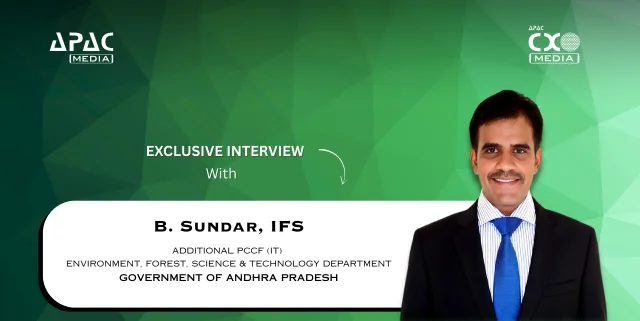
In this exclusive interview, B. Sundar, IFS, Additional Principal Chief Conservator of Forests (PCCF) (IT), Environment, Forest, Science and Technology Department, Government of Andhra Pradesh, discusses with APAC Media the growing role of information technology in forest governance.
He explains how digital tools such as GIS, satellite imagery, drones, and mobile applications are supporting forest protection and management while also addressing the practical challenges of implementing technology in field-based operations. The conversation also touches on the state’s science and technology initiatives, including quantum computing, academic collaboration, and the need to balance innovation with on-the-ground realities in conservation.
How is IT being used to improve forest protection, monitoring, and enforcement? Can you share examples of digital tools such as GIS, satellite imagery, drones, or mobile apps being used on the ground?
Information technology (IT) is used as a tool for aiding the field-level officials in the Andhra Pradesh Forest Department (APFD). At the beat and the range level, core IT is used to create web forms and aid forest office management, which includes the following core functions: standardization of data for sawmill registration, plantation management, seedling stock assessment, status of forest offence cases, vehicle seizures, and the legal processes for their confiscation by the government.

IT is also being used to harness unmanned aerial vehicles for capturing the movement of fauna in difficult terrain, but the process and output require refinement. The Geographical Information System (GIS) tools, which include software like ArcMap and QGIS, are used to generate digitized maps of areas earmarked for active afforestation, compensatory afforestation, and management of degraded forests.
The Trimble GIS is used to connect data to the forest map and develop suitable afforestation plans.
A visionary HANUMAN web and mobile application for an end-to-end compensation module arising due to animal attacks, animal sightings, prevention of menace from monkeys, crowd management in forest-based temples, digital enrollment of volunteers for aiding biodiversity protection, etc., is being developed. Satellite imagery from Sentinel-2 is being used to assess open and partially degraded lands for evolving planting projects.
What challenges do you face in implementing IT solutions across diverse forest regions? How are forest staff trained to adopt and use new technologies effectively?
The main challenge in implementing IT solutions in forestry is the lack of relevant use cases and stymied technological savviness at the lower level of forest offices. Web forms for developing MIS dashboards were prepared for use in the APFD, but due to a lack of usage, the outcomes were not affirmative. The users evinced cursory interest due to the extra efforts involved. Lack of IT resources for maintenance and porting newer technologies is yet another constraint in the APFD.
The APFD staff are trained through online modules. However, the intense field nature of the forestry jobs renders IT-driven forest operations’ monitoring to a tertiary level. It may not always be possible to prioritize the usage of IT for seemingly straightforward manual activities like beat perambulation, species identification, forest fire management, and so on.
What key schemes and initiatives in science and technology (S&T) is the Andhra Pradesh government currently implementing?
The government is catalyzing the development of the ‘Amaravati Quantum Valley (AQV),’ where a multi-qubit quantum computer with associated hardware and software ecosystem is proposed to be installed in 2026.
The modalities for engagement with the software development community are under evolution. It may be observed that IT firms like IBM have been offering quantum computers (as quantum processing units, or QPUs, with 120 qubits, 133 qubits, and 156 qubits) on the cloud for the past 5 years, where users can register free of cost. Each user is provided with 10 minutes of quantum processing time per month, free of cost, which is sufficient to implement a wide variety of quantum algorithms and quantum programming snippets. The AQV should differentiate its offering in the above quantum ecosystem through a slew of quantum programming paradigms.
The subject of quantum physics and quantum computing is proposed to be taught to students in high school and colleges at scale. Various models, like the training-of-trainers and online courses in quantum through vendors in the quantum space, are planned in parallel, thereby imparting a massive push to quantum science. The quantum initiative is anchored by the Information Technology Department.
The core subjects in forest science are taught in the Andhra Pradesh Forest Academy, Rajamahendravaram, for in-service department officers in subjects like silviculture, forest survey, wildlife management, and community forestry. The subject ‘Information technology applications in forestry’ is under revamp.
How do universities and research institutions contribute to the state’s science and technology ecosystem?
Forestry and silviculture are well-recognized courses in the horticulture and agriculture universities of the state. However, not many students evince interest in collaborating and implementing their academic projects with the APFD and its sister organizations, like the Andhra Pradesh (AP) Forest Development Corporation, the AP Biodiversity Board, and the AP Pollution Control Board. The faculty, however, participates in APFD-led conferences relating to mangrove forest management, man-animal conflict, and coastal zone management. The faculty also participates as expert committee members in the public hearings of the AP Pollution Control Board and the AP Coastal Zone Authority and helps in deciding complex litigation that interfaces with forests and biodiversity.
What kind of partnerships exist between the government, industry, and the S&T ecosystem to develop practical, technology-driven solutions for conservation and sustainability?
The vendor engagement and the industry interaction are somewhat limited in the APFD, since forest conservation and sustainability are regulated activities, similar to the police and the excise departments. APFD engaged with the GIS industry to explore IT applications but found the cost of GIS industry engagement prohibitively expensive, given the limited budget constraints. Open-source solutions and other optimal opportunities are being explored.
Andhra Pradesh has long been an advanced state in IT, and it is now stepping up efforts in science and technology as well. What steps are being taken to ensure strong convergence between IT and science and technology initiatives?
IT is an integral part of and a subset of science and technology. The Government of Andhra Pradesh is providing a huge impetus to quantum computing, as explained earlier. This propulsion would create an increased curiosity for quantum physics, physics, chemistry, biology, and mathematical sciences, and one would expect more students to join the science stream at the college level. Since the students’ set is bound numerically every year, there may be an adverse impact on sister streams like the humanities, arts, and social sciences, as there may be fewer students who would be enrolling to study these subjects at the college level.












Discussion about this post