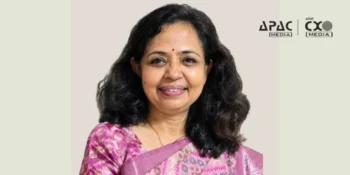






















New Delhi: As India hosts the IndiaAI Impact Summit at Bharat Mandapam, Nivruti Rai, MD & CEO of Invest India, laid out a stark, numbers-driven assessment of where India stands in the global AI and digital infrastructure race and the current status of the ecosystem.
Setting the context, Rai said India currently has 1.4 gigawatts (GW) of data centre capacity, roughly one watt per person. In comparison, China has 20 watts per person, while the US has 150 watts per person. “We are talking about a digitalisation journey. You absolutely need the data centre,” she said, underlining that expanding capacity is non-negotiable.
India aims to scale data centre capacity to 6.6 GW by 2030, more than tripling current levels. Achieving this would require $17 billion annually, she said. Building one GW of data centre infrastructure in India would cost $7-8 billion, compared to $12-13 billion in the US, excluding chips. “So we are cheaper, but we need to build more,” she noted.
Globally, data centre capacity stands at around 80-90 GW and is expected to double in the next three to four years. That expansion alone will require 50 million CPUs, seven million GPUs and three billion memory devices for hyperscalers, even before factoring in AI-specific demand. Hyperscalers currently allocate about 15 per cent of compute to AI workloads.
Rai added that doubling capacity would also require one billion storage devices. To meet CPU and GPU demand for hyperscalers, “There is a need for two complete fabs to be working on data centres alone,” she said. For sub-3-nanometre manufacturing, only five fabs globally are producing around 40,000 wafers per month; two are already consumed by data centre demand.
On high-bandwidth memory (HBM), essential for servers and GPUs, global capacity stands at 540,000 wafers across five fabs. With demand already at 200,000 wafers and expected to double, at least 10 fabs will be required.
“So, out there, if you are looking at investing, please invest in memory fabs,” she urged, welcoming commitments from Micron Technology (which is set to begin its productionat its ATMP facility in Sanand) and expressing hope that South Korea’s SK Hynix would expand capacity.
She also pointed to rising AI workloads, noting that while AI accounts for roughly 50 per cent of US workloads today, it could reach 71 per cent by 2030, sharply increasing GPU and memory requirements.
Beyond infrastructure, Rai highlighted India’s growing role in global AI operations. Many Global Capability Centres (GCCs), she said, are running AI workloads from India.
During recent regional tensions between India and Pakistan, “the GCCs were more worried about internet stocks that will do the AI work,” she remarked, underscoring India’s deep integration into global AI value chains.