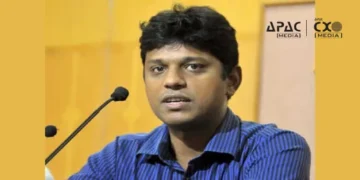













The ultimate goal at IIIT Hyderabad is to teach students how to learn faster, better, & continually, ensuring that they not only keep pace with the industry but also actively shape the future of technology. In an exclusive interaction, Prof. Sandeep Shukla, Director, IIIT Hyderabad, explains to Vidushi Gupta, Reporter at APAC Media how IIIT Hyderabad seeks to reinvent education, teaching, and the learning ecosystem for an evolving technological future.
How is IIIT Hyderabad aligning its academic structure with emerging industry expectations and evolving job roles?
The Reality: Evolving Technology Landscape
The digital landscape is evolving at an unprecedented, exponential speed. We are witnessing the simultaneous convergence of groundbreaking frontiers:
- Artificial Intelligence: The shift from Generative AI to autonomous Agentic AI.
- Hardware and Infrastructure: Sub-3nm transistors and next-generation advanced
GPUs. - The Quantum Horizon: Quantum sensing and scalable Quantum Computing.
- Next-Gen Connectivity: The dawn of 6G communications.
Because of this breakneck speed, the traditional, slow-moving pace of academic curriculum design is officially obsolete. We must fundamentally reinvent our curriculum, pedagogy, teaching methodologies, and evaluation frameworks.
The Industry Concerns
The industry itself is actively trying to navigate the practicalities and perils of this new era:
- The True Cost of AI: Companies are evaluating the real ROI of AI—balancing genuine
productivity gains against token costs, API expenses, data centre overhead, and the
critical secondary costs to our climate. - The Post-Quantum Threat: Businesses must aggressively transition to post- quantum cryptography now to protect themselves against sudden availability of sufficiently capable quantum computing.
- Opportunistic Connectivity: Enterprises are weighing how to leverage 6G and AI-
driven, opportunistic bandwidth utilization to achieve hyper-fast communications. - AI-Driven Cyber Warfare: The rise of sophisticated, AI-assisted cyberattacks forces the industry into a perpetual, high-stakes defensive posture.
A New Graduate Profile
In an environment defined by constant disruption, our educational mandate must change. We can no longer afford to graduate “one-trick ponies”—students who are highly specialised in just one static role, such as a traditional programmer, a QA engineer, or a software architect.
Instead, we must cultivate a new generation of versatile professionals by focusing on three pillars:
- Continuous Reinvention: Students must master the meta-skill of learning how to learn. They need the agility to reinvent themselves continually as technologies evolve and entirely new application spaces open up.
- Technology-Agnostic Problem Solving: The focus must shift from teaching specific technical tools to teaching holistic problem- solving. Technical skills are secondary and fluid; the ability to diagnose a real-world problem and deploy the right combination of emerging technologies to solve it is what matters.
- Human-AI Synthesis: We must double down on core human capabilities. Our graduates must know how to communicate masterfully, collaborate seamlessly in dynamic teams, and effectively coordinate a blended workforce of human talent and AI systems.
We are standing at a critical precipice. As educators, our responsibility is no longer just to integrate new technologies into an existing syllabus. We must completely reinvent ourselves. Our ultimate goal is to teach students how to learn faster, better, and continually ensuring they do not just keep pace with the industry but actively shape its future.
In what ways are digital technologies and AI-driven tools being integrated into teaching and learning practices across disciplines at the campus?
Transforming AI Integration in Education: From Ad Hoc to Systemic
Currently, the integration of digital technologies and AI-driven tools in education is largely ad hoc. Moving forward, it is essential to transition into a structured, systematic approach. To achieve this, we are executing a two-step strategy focused on policy framework and dedicated research, underpinned by active student engagement.
Step 1: Establishing a Strategic Institute-Level AI Policy
We have formed a committee to draft a comprehensive, institute-wide AI policy. Rather than being overly prescriptive, this policy will serve as a high-level strategic framework, allowing flexibility based on faculty, course type, and subject matter.
Key elements of this policy include:
- Constructive Integration Over Prohibition: Much like the adoption of calculators in
the past, AI is becoming a fundamental tool for problem-solving. Denying its role is
counterproductive; we must choose to guide its constructive use. - Faculty Autonomy: Individual faculty members will establish tailored, course-level AI guidelines that fit their specific curriculum.
- Defined Academic Boundaries: The framework will outline appropriate AI usage across classroom teaching, student assignments, and academic research.
- Developing Critical Discernment: A primary focus will be teaching students how to critically evaluate, verify, and filter AI-generated content and decisions.
Step 2: Launching a Dedicated Educational Research Centre
To understand and actively shape how AI impacts learning, we are establishing a specialised research centre. This centre will focus on:
- Pedagogy and Instructional Technology: Developing and testing AI-enhanced
methodologies, tools, and teaching techniques that measurably improve learning
outcomes. - Workforce Readiness: Preparing students for a future where AI is a pervasive tool
across industry, academia, and government.
Fostering Transparent Dialogue
Crucial to this transition is maintaining an honest, ongoing dialogue with our students. By actively listening to how they currently use these tools and understanding how they perceive AI’s role in their future readiness, we can ensure our institutional strategy remains relevant, ethical, and impactful.
What initiatives are being taken to continuously upskill faculty so they can deliver technology-enabled and application-oriented education?
IIIT Hyderabad is a research-centred institute by design. Instead of traditional academic
departments, the institute is built around collaborative Research Centres. Academic programmes (such as B. Tech in CSE/ECE or Dual Degrees in Computational Linguistics and Computational Human Sciences) are offered collectively by these centres. While the curriculum deliberately emphasises deep research over mandatory institutional internships, students gain substantial, high-impact industry exposure through several key pathways:
Collaborative & Sponsored Industry Projects
When faculty members partner with corporate entities, students actively participate in industry-sponsored projects. These engagements frequently involve students spending dedicated time working directly on-site within the partner companies, bridging the gap between academic theory and corporate application.
Translation Research Centres and Intellectual Property
Beyond core academic research, IIIT Hyderabad hosts dedicated Translation Research Centres. Students take foundational research generated in core labs and work on translating it into real-world applications. This pipeline directly results in patents, intellectual property (IP) creation, and direct technology transfers to industry partners.
Large-Scale National and Ministry Initiatives
Students gain experience handling massive, complex systems by contributing t major ministry-sponsored initiatives. Examples of these large-scale deployments include:
- Project BHASINI (Language translation technologies)
- National Biometric Implementations
Innovation Hub
Funded by the Department of Science & Technology (DST), the institute operates a specialised Innovation Hub. Within this ecosystem, students build, test, and refine projects that culminate in functional prototypes for commercial use or finished, market-ready products. We also have a large and vibrant incubation facility where at a time more than 90 start ups are incubated and hosted and students often work part time in some of these startups.
Although roughly half of our undergraduate students choose to pursue traditional summer corporate internships, the majority dedicate their summers to internal research centres. By the time they graduate, this unique ecosystem ensures they are not only seasoned researchers publishing in top-tier journals, but are also deeply exposed to large-scale, industry-relevant engineering.
How does IIIT Hyderabad focus on developing employability skills such as problem- solving, adaptability, and innovation alongside academic knowledge?
Our organisation uniquely fosters problem-solving, adaptability, and innovation by embedding undergraduate pedagogy directly within our research-centre architecture. From early in their academic journeys, students are integrated into both core and translational research environments, making hands-on project execution a cornerstone of their education.
Through this immersive, project-based learning model, students regularly navigate end-to-end project lifecycles. This continuous exposure to real-world challenges inherently builds their ability to adapt to fluid technical landscapes, innovate under constraints, and solve complex problems. Nationally, this approach sets our institute apart; unlike conventional curricula in India, our undergraduate framework is deliberately designed around active research, ensuring our graduates possess the practical agility required for high-impact careers.
What is the institute’s long-term vision for building a future-ready learning ecosystem that combines technology, skills, and industry relevance?
IIIT Hyderabad is an institute with a difference. Our vision for creating a future-ready workforce is fundamentally built around preparing students with the 3Cs: Competence, Curiosity, and Care.
First, we ensure deep Competence by grounding our students in strong fundamentals—not just in their core technical subjects, but also through a broad-based education in the humanities, social sciences, and basic sciences. We train them to be exceptional problem solvers who can take a highly complex challenge, break it down systematically, and execute solutions using the cutting-edge tools and techniques they have mastered.
Second, we spark their Curiosity. We want our graduates to look beyond the boundaries of their specific disciplines and ask big questions about technology, the economy, society, and the human condition. This curiosity ensures they are always looking to solve problems that genuinely matter.
Finally, we instill Care. A future-ready professional must be an empathetic one. We want our students to use their skills to improve society, preserve the environment, and elevate the planet.
With this holistic vision guiding us, we continuously re-invent our education, teaching, and learning ecosystem, ensuring that as the world evolves, our students are always prepared to lead it.