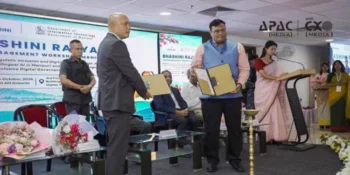














New Delhi: The Safe Water Network, USAID and WRI India jointly convened the session on ‘Making Cities Water Positive Through City Water Balance Plan’ in Stockholm Water Week’s first day on Monday. The Director General, National Mission for Clean Ganga (NMCG) Rajiv Ranjan Mishra participated in the session as key panellist and shared his valuable insights on ways to make cities water positive .
‘Making Cities Water Positive through City Water Balance Plan e-Toolkit’ was launched comprising 7 modules and 29 tools to assist the decision makers in developing and implementing solutions for making Cities Water Positive. The below given infographic represents the City Water Balance Approach developed for practitioners at ULB level.
Rajiv Ranjan Mishra, Director General, National Mission for Clean Ganga talked about the river rejuvenation, restoration, and monitoring of Ganga. He emphasized on rejuvenating and restoring the villages, town, and cities habituated along river Ganga or other water bodies. By explaining the holistic vision of Namami Gange Mission he pointed out the importance of creating built environment with focus on landscape compatibility with water cycle and riverine system. According to him, it is important to learn to live with rivers and develop cities and urban designs which are water sensitive, sustainable and integrated in its approach.
The Hybrid Annuity Model (HAM) has been adopted by NMCG to focus on the performance-based operations and monitoring of the STPs developed within Namami Gange Programme as earlier the model was only limited till the construction of infrastructure. He expressed satisfaction that now this model is being adopted outside Ganga Basin too as Hyderabad is taking lead in awarding STPs on HAM. He closed his remarks by highlighting the need to adopt reuse and circular economy and integrating rivers at city planning. Also including capacity building and focusing on rejuvenation and restoration of lakefronts along with riverfronts.
V.P. Singh Director (AMRUT-II), Ministry of Housing and Urban Affairs explained the uniqueness of Jal Jeevan Mission (Urban) with focus on integrated approach for achieving urban water management. He explained different initiative taken under AMRUT I& II for urban water management at city level.
The Managing Director, Hyderabad Metropolitan Water Supply & Sewerage Board, M. Dana Kishore explained the water security and impact issues at city level with special case of Hyderabad city (also recognised as water plus city in 2021).
The key feature of Water Resource Efficiency focused on solving the leadership crisis issue by involving app-based approach to create 14000 leaders at community level. They were trained on creating awareness and practicing self-monitoring system with focus on rainwater harvesting system, water availability and so on.