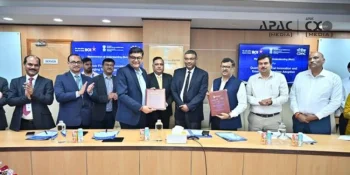


















Noida, Sep 21 (APAC Media): Semiconductor equipment major ASML has started operations in India and will initially hire 20-30 engineering graduates, with the pace of its expansion linked to the growth of the country’s semiconductor ecosystem and the success of Tata Electronics’ chip manufacturing project, a senior company executive said.
ASML Executive Vice President and Head of Customer Support Lin Kiat Yap said the company has already begun its India operations and would initially maintain a small team.
“Right now,” Yap told PTI on the sidelines of SEMICON India 2026 when asked when ASML would begin operations. “We are probably going to start off with 20-30 people. We will see how fast it scales. It really depends on the ambitions of India, and it really depends on the ambitions of Tata.”
ASML supplies advanced lithography technology used to manufacture semiconductor chips by transferring circuit patterns onto silicon wafers. Its equipment is critical to the production of advanced chips.
Yap said Tata Electronics was taking the first steps towards building a semiconductor ecosystem in India and stressed the need for more players to enter the sector.
“I think it’s good that Tata is taking the very first steps in seeding the ecosystem. I think it’s also very important to continue to grow the ecosystem, to bring in a second player, to bring in a third player,” he said.
“We want to make Tata successful because I think when people see Tata being a success, I think people will start to spend a little bit more time, be a little bit more focused in India and see the potential opportunities,” Yap added.
ASML Chief Strategic Sourcing and Procurement Officer Allan Wayne said Tata Electronics is the company’s first customer in India with a 300-mm semiconductor fabrication plant, which is planned to have a production capacity of 50,000 wafers per month.
“If we’re going to be scaling this up, we need to be able to build many fabs here,” Wayne said, citing government policies and India’s engineering talent as factors supporting the semiconductor ecosystem.
Wayne said India’s stated ambition of meeting a larger share of domestic semiconductor demand through local manufacturing would require several fabs.
“As you go on into 2032, India’s projection and India’s ambition are to have between 15 per cent and 25 per cent of the wafer fab of India’s local semiconductor demand. That means you’re going to have several fabs by 2032,” he said.
The government has announced the Semicon 2.0 scheme with incentives of around Rs 1.27 lakh crore to develop the semiconductor ecosystem. Union Minister Ashwini Vaishnaw has said investment proposals worth USD 12 billion are likely under the new scheme.
Tata Electronics’ semiconductor fab is scheduled to begin operations in 2028. Wayne stated that timely execution, quality, and production yields will be crucial for the progress of the project.
“I think it’s important that this first 300-mm fab in Tata is able to test and qualify, have excellent quality and yield and hit on schedule so that there are no delays,” he said.
–ENDS–
Disclaimer: This article is for informational purposes only and is based on publicly available information. APAC Media is not responsible for investment decisions or losses. Please conduct your own research or consult a financial adviser before investing.
Also Read: