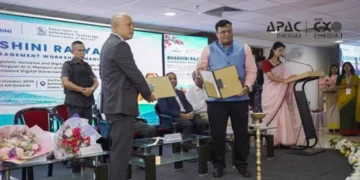










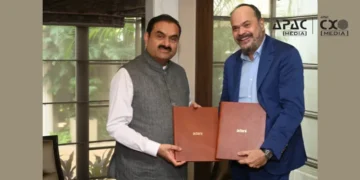












New Delhi: In a landmark step for India’s space sector, the 100th Technology Transfer Agreement (ToT) facilitated by the Indian National Space Promotion and Authorization Centre (IN-SPACe) was signed between the Indian Space Research Organisation (ISRO), NewSpace India Limited (NSIL), and Hindustan Aeronautics Limited (HAL) for the production of the Small Satellite Launch Vehicle (SSLV).
The agreement is aimed at advancing India’s space technology capabilities while expanding commercial opportunities in the global launch market.
Technology Transfer Timeline
The transfer process will be completed within 24 months of the signing. In this period, ISRO will provide training and technical support to HAL, enabling it to acquire complete know-how of SSLV production—from commercial processes to technology integration. The arrangement follows HAL’s selection as the successful bidder in a competitive process managed by IN-SPACe in June 2024.
Under the agreement, HAL will carry out two SSLV missions, with ISRO ensuring knowledge transfer and technical guidance. The initiative is expected to strengthen India’s capacity to meet the growing demand for small satellite launches both domestically and internationally.
ISRO’s Perspective
Highlighting the significance of the agreement, Dr. V. Narayanan, Secretary, Department of Space, and Chairman, ISRO, said, “With India’s liberalization of the commercial space sector, opportunities are certainly growing, and at ISRO, we have a dynamic technology transfer mechanism to realize the shared goals. This agreement is part of that movement, where ISRO will guide the HAL team on the preparedness-to-flight tangent of SSLV. This would define the next phase of deep-tech collaboration in space in India.”
IN-SPACe on Industry Empowerment
Dr. Pawan Kumar Goenka, Chairman, IN-SPACe, added, “The SSLV Technology Transfer signals a vital leap towards strengthening the industrial ecosystem within India’s space sector. ISRO, HAL, NSIL, and IN-SPACe coming together for the SSLV technology transfer signals a vital leap towards this endeavour and reflects the Government of India’s vision to empower the space industry and establish India as a global hub for affordable and reliable launch services. With this transfer, HAL will now independently take up the realisation of SSLV and cater to both domestic and international markets.”
HAL’s Commitment
On behalf of HAL, Dr. D K Sunil, CMD, stated, “We are honoured to be in this league to scale India’s next big frontiers with the SSLV technology by partnering with ISRO, NSIL, and IN-SPACe to operationalize it. HAL will apply its engineering and manufacturing strength to build SSLVs, train the required workforce, and progress towards building a self-reliant ecosystem so India can offer regular, cost-competitive small-satellite launches to domestic and global customers.”
Towards a Self-Reliant Space Future
The SSLV Technology Transfer Agreement marks a milestone in public-private collaboration, underscoring India’s resolve to build a self-reliant and globally competitive space ecosystem. It also positions HAL to play a key role in democratizing access to space, in line with India’s vision of becoming a global hub for small satellite launch services.
Also Read
IIT Kanpur’s C3iHub, ARAI Join Hands to Boost Automotive Cybersecurity Research