

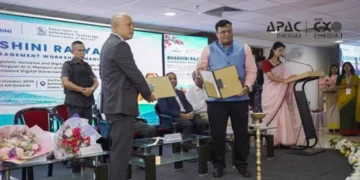



















New Delhi: Union Minister for Electronics and IT, Ashwini Vaishnaw, declared India’s rapid progress in the semiconductor sector as a defining achievement, stating that “within such a short time frame, we have first pilot line of CG semi starting production now… within 3 and 1/2 years from starting the program to getting into production,” at Semicon India.
Speaking at Semicon India 2025, he called the milestone “very important for our country,” reflecting how quickly India has advanced since launching the semiconductor mission in December 2021 and formally on 1 January 2022.
The minister said he presented the first chips from the pilot line to Prime Minister Narendra Modi during the event and confirmed that three more pilot lines are nearing completion.
“They will also start production,” he noted, adding that India is moving with unprecedented speed to establish its semiconductor ecosystem.
First ‘Made in Bharat’ Chips! 🇮🇳 pic.twitter.com/QYFGA4HFLG
— Ashwini Vaishnaw (@AshwiniVaishnaw) September 2, 2025
Calling it “a big milestone for our semiconductor industry,” Vaishnaw emphasised that India has achieved what few nations have managed, reaching chip production in just three and a half years.
He stressed that other approved projects, including those by Micron, Tata, CG and KENS, have also advanced rapidly, with permits cleared within 100 days of approval, setting a new benchmark that the government aims to maintain.
The minister highlighted progress across states, mentioning that in Odisha, land has been allocated for six semiconductor units and foundation work for silicon carbide plants will begin soon. Similarly, the ASIP-HCL Foxconn joint venture has identified land for its project, with development advancing steadily.
Vaishnaw also underscored the confidence of global semiconductor leaders in India’s trajectory.
“You would have noticed today we have from chemicals and gases, from equipment manufacturers, we have ASML, we have Lam, we have Applied Materials, we have Merck, we have Tokyo Electron. We have practically every large player in the semiconductor ecosystem present here. And they all feel very confident about our journey,” he said.
Talent development, he said, has been another cornerstone of the mission. With 278 universities now equipped with the latest EDA tools, over 60,000 students have clocked 13 million design hours. At the event, 20 student-designed chips manufactured in India were also showcased.
“Which country in the world can claim this kind of talent development program, friends?” the minister remarked at Semicon India.
He also announced Access, a billion-dollar alliance committed to supporting semiconductors and deep tech ventures, boosting India’s startup and innovation ecosystem.
“Our startups are earning the confidence of investors. Their IPs are increasingly embedded in products of leading international manufacturing facilities,” he said.
Citing strong demand, Vaishnaw pointed out that electronics production has grown sixfold and exports eightfold in the last decade. With demand for semiconductors rising across power, consumer, defence and automotive sectors, he urged global players to deepen their engagement in India.
“In these turbulent times, India stands as a lighthouse of stability and growth,” he said.
Reiterating Prime Minister Narendra Modi’s vision, Vaishnaw concluded, “I would like to reiterate what our Prime Minister said in 2024. Our Prime Minister said that when chips are down, you can bet on India.”