

















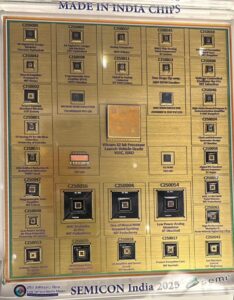
New Delhi: India’s semiconductor journey achieved a landmark milestone on 2 September as Prime Minister Narendra Modi was presented with the first set of Made-in-India chips developed under the India Semiconductor Mission (ISM) at Semicon India.
The chips, produced within three and a half years of the Mission’s launch in December 2021, mark the country’s transition from policy approvals to actual production.
Union Minister for Electronics and Information Technology, Ashwini Vaishnaw, described the achievement as a “moment of pride,” crediting the Prime Minister’s vision and decisive actions for enabling the breakthrough.
Highlighting India’s rapid growth, he said the country is now not only recording 7.8 per cent GDP growth but also emerging as a stable hub for global semiconductor innovation. He stressed that India’s trusted partnerships, respect for intellectual property and collaborative approach have become core strengths in the global semiconductor value chain.
At Semicon India 2025, twelve Memorandums of Understanding (MoUs) were signed, focusing on strengthening indigenous product development in areas such as camera modules, MEMS microphones, advanced packaging, secure chips and IoT systems.
The agreements also cover collaborations in design, manufacturing, talent development and global academic partnerships, including those with IIT Madras, IISc Bangalore and Arizona State University. Notably, Tata Electronics announced collaborations with Merck and C-DAC, while L&T Semiconductor signed agreements with IISc and C-DAC for innovation hubs and secure chip development.
In a major push for frontier technologies, the government announced the formation of a Deep Tech Alliance with a $1 billion commitment. Initially focused on semiconductors, the Alliance will expand to include clean energy, biotechnology, space and quantum technologies, providing vital venture capital support to emerging industries.
Vaishnaw also unveiled plans for ISM 2.0, which will focus on transforming India into a product nation by expanding beyond fabs and OSAT units to cover the entire semiconductor value chain, including capital equipment and materials.
He noted that India’s semiconductor production is already 15 to 30 per cent more cost-competitive than global benchmarks, with exports set to play a central role in upcoming projects.
Global leaders in the semiconductor ecosystem, including ASML, Lam Research, Applied Materials, Merck and Tokyo Electron, were present at the event, signalling strong international confidence in India’s semiconductor roadmap.
A unique highlight was the presentation of 20 student-designed chips from the Semi-Conductor Laboratory, Mohali, to the Prime Minister, showcasing the deepening role of universities in building a skilled workforce.
With 78 universities leveraging advanced EDA tools and Indian engineers comprising nearly 20 per cent of the global semiconductor workforce, talent development remains central to the mission.
Over 28 domestic startups have already progressed from projects to products, while indigenous processors and microcontrollers from institutions like IIT Madras are strengthening India’s design ecosystem.
As the global semiconductor industry is projected to reach a $1 trillion valuation by 2030, India’s blend of cost competitiveness, trust, and talent is positioning the country to emerge as a leading semiconductor hub, fulfilling the vision of making India a cornerstone of the global semiconductor supply chain.