





















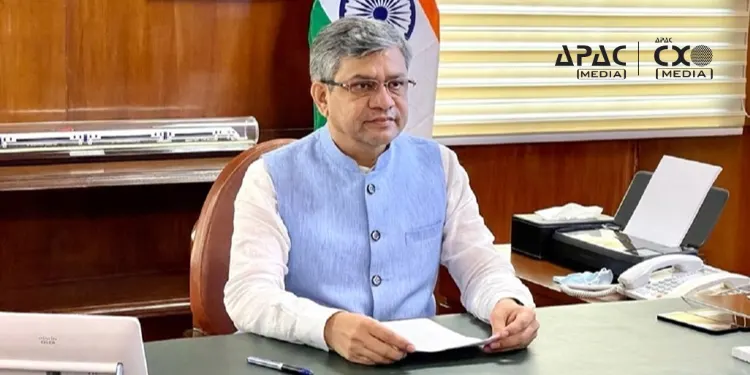
Noida, July 15 (APAC Media): The Union Cabinet on Wednesday approved the second phase of the India Semiconductor Mission (ISM) with a financial outlay of Rs 1.27 trillion, aimed at strengthening domestic semiconductor manufacturing, design capabilities, and the broader electronics ecosystem.
The Cabinet also cleared the second phase of the Mobile Phone Manufacturing Scheme with an outlay of Rs 62,500 crore, Union Electronics and Information Technology Minister Ashwini Vaishnaw said.
The semiconductor industry is a foundational industry. Semiconductor chips are required in almost every modern device and manufacturing sector. The entire electronics value chain has now been covered under this initiative,” Vaishnaw said while announcing the Cabinet decisions.
Patanjali Foods Share Price Falls 16% to Fresh 52-Week Low; Co. Clarifies on Sharp Stock Decline
He said the semiconductor ecosystem supports a wide range of sectors, including mobile phones; cameras; household appliances such as refrigerators, televisions, and air conditioners; automobiles; railways; and strategic equipment.
Explaining the complexity of semiconductor manufacturing, Vaishnaw said the industry involves a highly sophisticated value chain beginning with silicon ingots made from raw materials, followed by wafer production, fabrication, packaging, and testing.
“Semiconductor fabrication requires extreme precision. If writing a name on a fingernail is considered difficult, fabrication involves a level of accuracy comparable to writing an entire Ramayana or Mahabharata on that same fingernail,” he said.
Cabinet approves Mobile Phone Manufacturing Scheme (MPMS) with a budgetary outlay of ₹ 62,500 crore
➤ The scheme tenure shall be 5 Years i.e. from FY 2026-27 to FY 2030-31
➤ Government launched the scheme to further scale up the production, deepen domestic value addition,… pic.twitter.com/5AzWRKuMBP
— PIB India (@PIB_India) July 15, 2026
Under the second phase of the ISM, the government will provide a combination of grants and equity support for the development of strategic and commercial semiconductor chips in India. For manufacturing equipment, chemicals, gases, and materials required for the industry, the government will provide a flat incentive of 30 percent.
Vaishnaw said the overall investment under the semiconductor mission is expected to reach Rs 4 trillion, with estimated production of Rs 2 trillion and exports worth Rs 1 trillion.
As of July 15, 2026, the government had approved 12 semiconductor projects with a cumulative investment of more than Rs 1.60 trillion under the flagship Rs 76,000 crore India Semiconductor Mission.
“Of the 12 semiconductor chip manufacturing and packaging plants approved so far, three have already started commercial production,” Vaishnaw said.
The Rs 76,000 crore ISM was approved by the Union Cabinet in December 2021 to develop a complete semiconductor ecosystem in India. The mission cleared its first major project in June 2023, approving Micron Technology’s $2.75 billion semiconductor assembly, testing, marking, and packaging (ATMP) facility at Sanand, Gujarat.
Later in 2023, the government approved India’s first semiconductor fabrication project, a joint venture between Tata Group and Taiwan-based Powerchip Semiconductor Manufacturing Corporation (PSMC), involving an investment of around $11 billion, or Rs 91,000 crore.
The latest approvals mark a further push towards building domestic semiconductor capabilities and reducing dependence on global supply chains.
–ENDS–
Disclaimer: This article is for informational purposes only. APAC Media is not liable for any investment decisions or losses. Please conduct your own research or consult a financial advisor before investing.
Also Read: