


















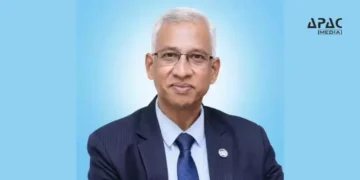









Mira-Bhayander Municipal Corporation believes in shared ownership of the city. Radhabinod Aribam Sharma, IAS, Municipal Commissioner & Administrator, Mira-Bhayander Municipal Corporation (MBMC), exclusively explains to Nisha Samant, Associate Editor, APAC Media, how the ‘Majha Ward, Majhi Jababdari’ program empowers citizens through ward-level action plans and monthly scorecards.
Mira-Bhayandar is one of the fastest-growing cities in Maharashtra. What are your top infrastructure priorities to manage rapid urbanisation?
Mira-Bhayandar Municipal Corporation (MBMC) is growing at a fast pace, and our priority is to build pothole-free, durable, future-ready infrastructure, especially roads and mobility systems.
The biggest push is towards Cement Concrete (CC) roads to make the city pothole-free. We have already completed 29 km, 45 km are in progress, and 27 km are proposed.
On mobility, MBMC along with other state agencies like MMRDA and BMC is executing large-scale connectivity projects including the Ring Road, Dahisar–Bhayandar Link Road, Metro integration, and key intra-city corridors. These together will form a ring-shaped mobility network that reduces congestion and supports economic growth.
MBMC is also focusing on strengthening the water supply, sewerage networks, and public service systems through the Surya Regional Scheme and AMRUT 2.0.
What are the major steps MBMC has taken to improve waste management and scientific disposal?
MBMC today stands as a nationally recognised ULB—Rank 1 in India (3–10lakh category) with the Hon’ble President of India Award for Swachh Survekshan 2024–25.
MBMC already ensures 100 per cent waste collection, ~80 per cent source segregation, and 100 per cent processing—a benchmark for urban centres.
MBMC operates one of India’s most advanced Digital Waste Management systems with QR-based mapping of all properties and GPS tracking of all vehicles. 
MBMC has adopted a hybrid waste processing model that is both Centralised (windrow composting and RDF) and Decentralised (biogas plants, ward-level composting, etc.).
Our RRR (Reduce, Reuse, Recycle) Centres and community programs have created strong behavioural ownership.
The upcoming projects include a Waste-to-Energy plant, CBG plant, C&D waste facility, and Digital Waste Monitoring 2.0.
A major transformation planned is the reclamation and greening of the Uttan dumping ground, turning wasteland into usable civic space.
Water supply equity is a challenge in most cities. How is MBMC ensuring fair distribution and long-term sustainability?
As a city without its own independent water source, MBMC relies entirely on bulk water purchase, making efficiency, reuse and NRW reduction absolutely critical.
MBMC is expanding the water grid through the Surya Regional Scheme and AMRUT 2.0 to enhance bulk and distribution capacity.
Reducing Non-Revenue Water (NRW) is a priority. We use SCADA automation, leak detection, pressure management, telemetry, and fully GIS-mapped assets.
We are expanding treated wastewater reuse through Green STPs, with ~35 MLD already reused for gardening, construction, and industrial needs.
Demand management, online tanker tracking, water audits, and public awareness help us build a responsible and resilient water system. MBMC has been recognised for its digital governance.
What are the key digital tools that have transformed service delivery?
We have built a comprehensive digital governance stack covering every major municipal function.
The key elements include:
- 100% e-Office with 23,000+ digitised files
- GIS-tagged One-Click Attendance
- Grievance Management with 85% complaints resolved within 24 hours
- RTS Monitoring for time-bound service delivery
- Visitor Management System for streamlined citizen interface
Citizen-facing platforms—MBMC website, mobile app, digital library, and GPS-enabled water tanker booking—have increased transparency.
In solid waste, QR-based property mapping, GPS monitoring, and a digital penalty system have improved compliance and brought Rs 65 lakh in penalties in nine months.
A unified digital stack now integrates property tax, water tax, tanker booking, grievance system, septic tank management, RTS services, library management, and visitor management—making governance fully transparent and accessible.
Climate resilience and green spaces are fast becoming core governance themes. What is MBMC doing on this front?
Our climate resilience programme covers flood prevention, heat mitigation, nature-based solutions, and digital environmental governance.
The major initiatives include:
- A citywide Climate Action Plan
- Flood-Free City Program with desilting and hydraulic upgrades
- Coastal vulnerability mapping
- A target of 50,000+ new trees
- The Miyawaki Forest at Uttan: 8,500+ trees and 49 indigenous species

- Expansion of treated wastewater reuse through Green STPs
- Environment department currently levies no direct environmental taxation.
- NCAP-backed mist spray systems (fixed, vehicle-mounted & trolley) are deployed across the city for air-quality control.
- Environmental dashboard modernisation is underway and will be relaunched with live data integration.
We are also integrating green/blue infrastructure in new DPRs and exploring global best practices such as Singapore’s saline water reuse model.
Citizen participation has become a central component of modern governance. What mechanisms has MBMC put in place?
We believe in shared ownership of the city. Our ‘Majha Ward, Majhi Jababdari’ programme empowers citizens through ward-level action plans and
monthly scorecards. We actively involve RWAs, schools, NSS/NCC, SHGs, BWGs, and NGOs in consultations and solution-building.
Digital participation through the Swachh MBMC app, open dashboards, and Visitor Management System has improved accountability.
‘Safai On Demand’ enables doorstep cleaning for hotspots and bulk waste with GPS-tracked response teams and defined turnaround time.
How does MBMC ensure transparency and accountability across its projects and departments?
Transparency is a governance priority for us. The key initiatives taken to bring transparency and accountability are:
- E-tendering ensures complete audit trails in procurement.
- e-Office and MIS provide time-stamped decision-making.
- MC War Room 1.0 and 2.0 monitor departmental KPIs and rank performance.
- Third-party audits validate major projects and DPRs.
- Attendance-linked salaries and clearly mapped responsibilities ensure human accountability.
Together, these systems create a culture of efficiency, integrity, and real-time oversight.





Discussion about this post