




















New Delhi: In order to enhance healthcare services, there is a need to leverage cutting-edge technologies such as AI, ML, and innovative solutions to address public health challenges. By incorporating these emerging technologies, healthcare systems can become more efficient and improve overall public health outcomes.
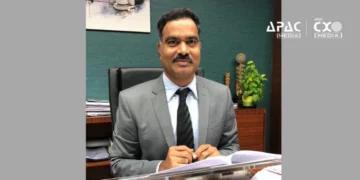
IAS Dr. Adapa Karthik, Special Secretary, Department of Health & Family Welfare and Special Secretary cum Director, Department of Governance Reforms & Public Grievances, Government of Punjab, spoke at the APAC 6th National HealthTech Innovation Conclave. He spoke on the topic ‘Enabling Public Healthcare With Emerging Technologies’.
“In first world countries, AI and ML applications are now built on multi-modal data. Essentially, machines do well in terms of their intelligence when they have all forms of data, and that is where AI and ML are going to go,” Karthik said.
What is multi-modal data?
Multi-modal data refers to data collected from various sources or modalities, such as text, images, audio, video, or sensor data, which offer different perspectives on the same subject. This data is diverse, complementary, and often complex to handle, but it provides a rich and comprehensive understanding of the subject by incorporating information from multiple sources.
Applications of multi-modal data analysis can be found in fields like computer vision, natural language processing, and healthcare, where it enhances the performance of machine learning models and analytical tools by leveraging the synergies among different data sources.
Karthik then talks about the Bengaluru deep-tech startup company called NIRAMAI Health Analytix, that aims to counter critical healthcare issues through automated solutions.
A little about Niramai’s Breast Thermography
Known as Thermalytix, Niramai’s Breast Thermography is a healthcare technology for the early detection of breast cancer. It employs a non-invasive approach using thermal imaging to detect temperature variations in breast tissue.
By analysing these temperature patterns with artificial intelligence, Niramai’s system can assess the risk of breast cancer and provide early warnings, potentially improving the chances of successful treatment. It is a comfortable and radiation-free screening option, often used as a supplementary tool alongside mammography, especially for women with dense breast tissue or those who cannot undergo mammography for various reasons.
“The Government of Punjab has been able to screen about 20,000 women using the thermography equipment augmented by AI. This is the first ever example in the entire world where you have a large-scale AI-enabled screening tool to basically detect abnormalities in breasts,” he said.
He said this innovation was possible because of the ecosystem in India where startups come up with very interesting ideas, followed by governments accepting these innovations and helping the roll-out of such large-scale projects.
“When startup, technology, science and the government come together, here is an example that is truly outstanding, not just to India, but around the world,” Karthik stated.
What is human-centred design thinking and participatory co-design processes?
Karthik said, “When you design technology, you want to think about the end user, what you call human-centred design thinking or participatory co-design processes.”
Human-centred design thinking is an approach to problem-solving and innovation that focuses on meeting the needs and preferences of the end-users. It involves empathising with users to understand their challenges, defining the problem to be solved, brainstorming creative solutions, building prototypes, and testing them with real users to gather feedback. This makes the final product or solution user-friendly and aligns with the users’ needs, making it a widely used approach in various fields to create more successful and user-centric designs.
Participatory co-design processes involve collaboration with end-users and stakeholders, emphasising inclusivity and empowerment. This enables diverse perspectives to shape the design of products, services, or systems, resulting in user-centric solutions that better address real-world challenges. This approach is valuable for complex or context-specific problems in various domains, encouraging active involvement and continuous feedback from those who will ultimately use the designed solutions.
Dr Karthik concludes by saying that the world has become a connected place, that there is a lot of interesting technology that is growing out in research and healthcare in the west, but there are also very interesting examples of great innovations happening within India as well.