


























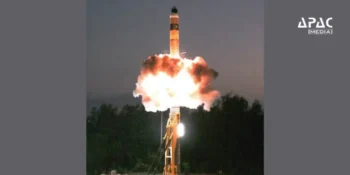
Andhra Pradesh: The Indian Space Research Organisation (ISRO) is set to launch its Space Docking Experiment (SpaDeX) on December 30, 2024, at 10:00 PM IST from the Satish Dhawan Space Centre in Sriharikota. This mission aims to demonstrate in-space docking technology, a critical capability for future space endeavors.
What is Space Docking?
Docking refers to the joining of two separate free-flying space vehicles. The docking capability of the spacecraft depends on space rendezvous, the ability of two spacecraft to find each other in the same orbit.
Mission Overview
SpaDeX is a cost-effective technology demonstrator mission designed to develop and showcase the technology required for the rendezvous, docking, and undocking of two small spacecraft in low-Earth orbit. The mission involves two spacecraft, SDX01 (Chaser) and SDX02 (Target), each weighing approximately 220 kg. These spacecraft will be launched aboard the Polar Satellite Launch Vehicle (PSLV-C60) into a 470 km circular orbit with a 55° inclination. Initially separated by about 5 km, the spacecraft will undergo a series of maneuvers over 10 to 14 days to gradually approach each other, culminating in docking at a distance of approximately 3 meters.
Significance of In-Space Docking
In-space docking technology is essential for India’s ambitious space projects, including human lunar missions, manned space missions, and the construction and operation of the Bharatiya Antariksh Station (BAS), India’s planned space station. Gaining expertise in this technology would enable the assembly of larger structures in orbit, refueling of spacecraft, and transfer of crew and materials between modules. Successful demonstration of docking capabilities would position India alongside countries like the United States, Russia, and China, which have previously achieved this feat.
Technological Innovations under the Mission
The SpaDeX mission incorporates several indigenous technologies, including:
A low-impact, androgynous docking mechanism designed for precision and reliability.
A suite of four rendezvous and docking sensors to facilitate accurate navigation and alignment.
Power transfer technology to demonstrate the transfer of electrical power between docked spacecraft.
An inter-satellite communication link (ISL) for autonomous communication between spacecraft.
A GNSS-based Relative Orbit Determination and Propagation (RODP) processor to determine the relative position and velocity of the spacecraft.
These innovations are crucial for the success of the mission and for future applications such as in-space robotics and autonomous docking needed for lunar missions like Chandrayaan-4.
Technical Challenges and Future Prospects- APAC News Analysis:
Achieving autonomous docking in space involves complex navigation, precise control, and real-time decision-making to ensure the safety and success of the operation. The SpaDeX mission will test these capabilities, providing valuable data and experience for ISRO. A successful demonstration could lead to advancements in satellite servicing, such as extending the operational life of satellites through refueling and repairs and facilitating ambitious projects requiring modular assembly in space.
The mission represents a significant milestone in India’s space program, showcasing ISRO’s commitment to developing advanced space technologies. The outcomes of this mission are anticipated to pave the way for more complex and collaborative space endeavors in the future.
















Discussion about this post