





























In districts where terrain, population pressure, and security risks intersect, elections test the very limits of governance. East Champaran in Bihar is one such district.
During the 2025 Bihar Assembly elections, however, East Champaran turned these challenges into an opportunity to demonstrate what good governance looks like in practice.
At the centre of this transformation was IAS Saurabh Jorwal, District Magistrate and District Election Officer of East Champaran.
Managing elections in East Champaran involves coordinating 4,095 polling booths across 1,905 locations, often in flood-prone and remote areas, while deploying 123 companies of Central Armed Police Forces (CAPF). Earlier, planning security deployment relied on manual processes that took days and were vulnerable to errors and uneven force distribution. Recognising these limits, the district administration chose to rethink the system from the ground up.

Under Jorwal’s guidance, an in-house, Python-based Geospatial CAPF Deployment System was developed using only open-source tools. With accurate GPS data for polling stations and security bases, the system optimised deployment scientifically, reduced travel distances, and ensured constituency-wise compliance.
What once took nearly a week was completed in under 20 minutes, with full transparency and auditability.

The innovation extended beyond planning. Security units and polling teams received auto-generated information sheets with booth details, routes, GPS coordinates, and QR-coded navigation links. For personnel unfamiliar with local geography, a single scan provided clear directions, even in difficult terrain. This reduced confusion, delays, and dependency on local support.

The district also adopted digital dashboards for booth mapping, live monitoring, and counting-day analytics. Pre-printed dispatch and receiving registers streamlined operations at distribution centres, while CCTV-based queue monitoring allowed officers to intervene quickly wherever voter lines grew long. All polling stations completed voting on time, without disruption.

The outcomes spoke for themselves. Voter turnout increased heavily when compared to the previous election, and female participation reached an impressive number. Most notably, the entire election process passed without a single incident of violence or law-and-order breakdown.

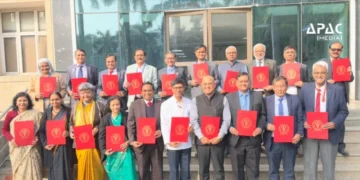
Jorwal’s leadership and technology-led approach earned national recognition, with the district receiving the Best Electoral Practices Award in the General Election Management category, conferred by the President of India.
East Champaran’s experience shows how technology, when aligned with ground realities, can strengthen democratic processes. The model is low-cost, adaptable, and easily replicable, offering a practical blueprint for election management across India. It is a reminder that good governance is not about grand gestures, but about smart solutions that make democracy work better for everyone!










Discussion about this post