











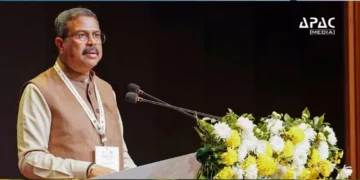















Digital initiatives at Sanskriti University represent a decisive shift toward a technology-driven, future-ready academic ecosystem. Dr Sachin Gupta, Chancellor, Sanskriti University, Mathura, speaks to APAC Media about how this digital transformation has helped Sanskriti become a digitally empowered institution.
How are the digital initiatives undertaken at Sanskriti University impacting the overall learning experience and simplifying administrative tasks?
Digital initiatives at Sanskriti University represent a decisive shift toward a technology-driven, future-ready academic ecosystem. Through laptop-enabled learning, classrooms have evolved into interactive digital spaces where students engage in simulations, live assignments, collaborative platforms, and project-based learning that mirrors real industry environments and global competencies. This approach moves learning beyond theory, fostering practical skills, innovation, and continuous engagement.
On the governance and support side, a tightly integrated digital framework—comprising the University ESIM ERP, INFLIBNET-LMS connectivity, STUDIUM Data Management System, the KOHA-based digital library with extensive e-books & scholarly journals, and the Hostel ERP (Fretbox) with ease of accessibility have transformed administration, academics, ICT and Research. Core processes such as admissions, attendance, examinations, academic tracking, and grievance redressal are now faster, transparent, and largely paperless.
These initiatives have redefined how the University operates: decisions are data-driven, responses are immediate, and workflows are seamless. This digital transformation allows Sanskriti University to focus decisively on academic excellence, skill-centric education, and a student-centric, digitally empowered institution.
In terms of developing a digital campus, how would you assess Sanskriti University’s progress?
Sanskriti University’s progress as a digital campus has been strong, consistent, and purpose-driven. Rather than adopting technology as a formality, the University has focused on digital systems that genuinely improve learning, governance, and student experience.
Academically, smart classrooms and laptop-enabled learning have transformed teaching into an interactive process involving digital content, simulations, live assessments, and project-based learning aligned with industry practices. This has helped students develop practical skills alongside conceptual understanding.
Administratively, the integrated digital data management systems, such as ERP and LMS, manage admissions, academics, faculty load, attendance, examinations, and student records, leading to faster processing, improved accuracy, and transparent decision-making. Digital Library ensures continuous access to academic and research resources. The Hostel ERP has further strengthened student support through efficient service management and quicker grievance redressal. While Database Management Systems put universities ahead in readiness for various ranking and rating purposes.
Overall, Sanskriti University has moved beyond basic digitisation to functional digital maturity, where technology is embedded in everyday academic and administrative workflows. This has reduced procedural delays, improved responsiveness, and allowed greater focus on academic quality, innovation, and industry readiness, marking the University as a forward-looking digital campus.
How is Sanskriti University focusing on industry-ready degree programs with different specialisations?
Sanskriti University designs its programs with a clear focus on industry requirements and employability. The curriculum is regularly updated to reflect emerging technologies, changing market needs, and new career pathways.
Specialisations are deliberately diverse and interdisciplinary, allowing students to combine technical knowledge with management, creativity, and entrepreneurial thinking. A science student, for example, gains exposure to business and innovation, while management students engage with technology and analytics. In addition, Earn While Learn programs enable students to gain practical industry exposure alongside their studies, strengthening both skills and confidence.
How is Sanskriti collaborating with the industry for these courses?
Industry collaboration is deeply integrated into academic delivery at Sanskriti University. We work closely with leading organisations such as IBM, TCS, Wipro, Microsoft, Infosys, AWS Academy, CISCO, Deloitte, JCB, Tata Group, along with major healthcare and hospitality partners.
Additional collaborations with HCL, FACE Prep, NxtWave, PixelPop, Emversity, Avaan, CyberDojo, Lernnern Pvt. Ltd., Apollo Hospitals, Cosmic Creative Academy (CCA), JD Institute of Fashion Technology, ICA, and Punjab Kesari support curriculum design, certifications, internships, live projects, and skill training. Regular expert sessions, Business Conclaves, and pre-placement programs ensure students are continuously connected with industry expectations.
How is Sanskriti leveraging AI and other new-generation technologies to enhance communication and creativity within the University?
Sanskriti University strategically leverages Artificial Intelligence and new-generation technologies to enhance communication, creativity, and overall academic excellence. AI is integrated both as a core area of study and as an operational tool to automate routine and time-consuming processes, thereby improving efficiency across academic and administrative functions. This enables students and faculty to dedicate greater time to critical thinking, research, innovation, and creative problem-solving.
The University also uses AI-enabled systems to support personalised learning pathways and advanced academic analytics, helping identify student needs, track progress, and improve learning outcomes. These data-driven insights contribute to more informed decision-making and targeted academic support.
To foster experiential learning, Sanskriti University has established state-of-the-art laboratories in Artificial Intelligence, Robotics, Cyber Security, Big Data, and Automation. These facilities allow students to experiment with emerging technologies, develop innovative solutions, and gain hands-on experience with real-world applications.
In addition, the University promotes industry exposure and thought leadership through initiatives such as the National Seminar on “Leveraging AI for Future Businesses,” which brings together experts from academia and industry to discuss practical AI applications and entrepreneurial opportunities.
Through continuous integration of AI, modern digital infrastructure, and strong industry collaboration, Sanskriti University is building a connected, creative, and future-ready academic ecosystem aligned with the evolving demands of the global digital economy.
What are the dynamics of your collaboration with the ICT Academy?
The collaboration between Sanskriti University and ICT Academy is centred on strengthening academic quality and industry relevance through faculty upskilling, industry-aligned certification programs, and practical skill development for students. This partnership supports structured training initiatives and curriculum enhancement to ensure that teaching methodologies and student competencies remain closely aligned with evolving industry standards and future workforce requirements, thereby improving graduate employability.
As part of this collaboration, Sanskriti University hosted a specialised training program on Python, Artificial Intelligence, and emerging technologies, conducted by the ICT Academy in association with Infosys at the university campus. The program provided hands-on exposure to modern tools and technologies, equipping both students and faculty with practical, industry-relevant programming and AI skills, and effectively bridging the gap between academic learning and real-world technology applications.
How is Sanskriti promoting research and innovation, particularly under the provisions of NEP 2020?
Research and innovation are integral to Sanskriti University’s academic ecosystem. With 3058+ patents filed, the University ranks among the top patent-filing institutions in India, supported by a SIRO-certified research framework, 2700+ research publications, and a strong Central Research Facility.
In line with NEP 2020, research is promoted across disciplines and academic levels, encouraging multidisciplinary learning and innovation. A MeitY-approved incubation centre supports 100+ startups, enabling students and faculty to convert ideas into patents, products, and enterprises. This approach ensures that research at Sanskriti is practical, impactful, and aligned with national priorities.
















Discussion about this post