



















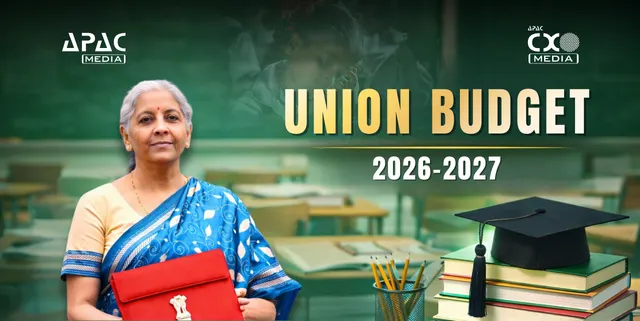
New Delhi: The Union Budget 2026–27 places education and skilling at the centre of India’s long-term growth strategy, with a strong focus on technology adoption, industry alignment, and inclusive access.
The proposed measures aim to equip India’s workforce for a rapidly evolving economy while ensuring that the youth gain skills that are closely aligned with industry needs.
Education to Employment Focus
A High-Powered ‘Education to Employment and Enterprise’ Standing Committee will be set up to recommend measures for strengthening the services sector as a key driver of Viksit Bharat. The committee will work towards positioning India as a global services leader by 2047. It will identify priority areas for growth, employment and exports, while also assessing the impact of emerging technologies, including AI, on jobs and skill requirements.
University Townships and Support for Women in STEM
Through a challenge-based approach, the Centre will support states in creating five University Townships near major industrial and logistics corridors. These hubs will host universities, colleges, research institutions, skill centers, and residential facilities, fostering stronger links between education, research, and industry.
To address challenges faced by girl students in STEM institutions, the budget proposes setting up one girls’ hostel in every district with viability gap funding (VGF) support.
Boost to Science, Hospitality, Tourism, and Textile Skills
To promote astrophysics and astronomy, four major telescope infrastructure facilities will be set up or upgraded, including the National Large Solar Telescope and the Himalayan Chandra Telescope.
The government also announced the creation of a National Institute of Hospitality by upgrading the National Council for Hotel Management and Catering Technology.
In tourism, a pilot scheme will upskill 10,000 guides across 20 iconic sites, alongside the launch of a National Destination Digital Knowledge Grid to document India’s cultural and heritage assets and create new knowledge-based jobs.
To modernise the textile skilling ecosystem, the government announced Samarth 2.0, which will upgrade training frameworks through closer collaboration with industry and academic institutions. The initiative seeks to make India’s textile workforce more competitive and aligned with current and future industry needs.
Experts’ Opinions
Arnav Kumar, co-founder of Leap, said, “The Union Budget’s education thrust signals a decisive shift from enrolment to employability. By formally anchoring an Education-to-Employment pipeline, investing in creator-economy skilling at scale, and building university townships closer to industry corridors, the government is recognising that higher education must translate into real career outcomes. For students aspiring to study abroad, the reduction in TCS on education remittances meaningfully eases cash-flow pressure and improves access. Taken together, these measures reinforce India’s ambition to produce globally competitive talent – where education is a launchpad for international careers and entrepreneurship.”
Also Read
Union Budget 2026–27: High Value, Tech-Led Agriculture at the Core of Inclusive Growth















Discussion about this post