




















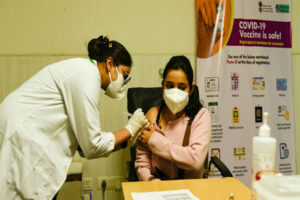
 New Delhi: Several theories abound and many vaccines too have flooded the market but experts are of the opinion that the second wave of the COVID-19 pandemic could be tackled by following norms and Covid appropriate behaviour. Experts caution that the next wave could be less severe if people keep following COVID-appropriate behaviour and a large portion of the population is vaccinated.
Frequent handwashing, sanitising and maintaining physical distance apart from keeping away from crowded places is the most effective way of controlling the spread of Covid-19 virus.
Virus starts a chain of transmission by infecting the most vulnerable population and it keeps infecting till the time everyone susceptible is infected and then it starts dying out.
K VijayRaghavan, Principal Scientific Adviser, had said on Wednesday last week that the third wave was inevitable and it was necessary to be prepared for new waves, but clarified two days later that the “insidious asymptomatic transmission” can be stopped if prescribed guidelines about precautions, surveillance, containment, treatment and testing are followed.
“If we take strong measures, the third wave may not happen in all places or indeed anywhere at all. It depends on much how effectively guidance is implemented at the local level in the states, districts and cities everywhere,” he said.
According to experts, in a few months when the immunity people have developed naturally or with the help of vaccination fades, the virus strikes again and the only thing that can stop the virus from bouncing back is how people are guarding themselves.
“Early this year, as the new cases receded, people started interacting as if there was no virus. The immunity had already started declining. They organised mass gatherings, they stopped wearing masks, giving the opportunity to the virus to strike again,” said Dr Anurag Agarwal, director, Institute of Genomics and Integral Biology, New Delhi.
“While we anticipate a third wave, we cannot say when exactly it will come or how severe it will be. But if people keep following COVID-appropriate behaviour in coming months and we are able to vaccinate a large number of people, the third wave could be less severe,” Dr Agarwal added.
Some experts, however, believe that mutations are a common phenomenon, and the mutations do not generally affect the prevention, treatment, or vaccination.
“Every virus, while replicating in the host’s body, mutates. The virus is a prolific multiplier, but its replication is error-prone and so every copy it makes of itself may not be its exact replica.”
“Any change, minor or major, that occurs in its structure is known as a mutation. A virus undergoes hundreds and thousands of such mutations,” said Dr Saumitra Das, Director, National Institute of Biomedical Genomics (NIBMG), Kalyani, and professor, Indian Institute of Science, Bangalore.
Experts also said that every mutation cannot be a cause of concern and genome sequencing of a virus is done to keep a track of any mutation that can make a virus more dangerous.
“What concerns us is whether a mutation is making it more transmissible, or virulent; whether a mutation has the potential to make the existing medicines or vaccines ineffective against the virus. If so, the mutant is classified as a variant of concern (VoC),” said Dr Das.




















Discussion about this post