























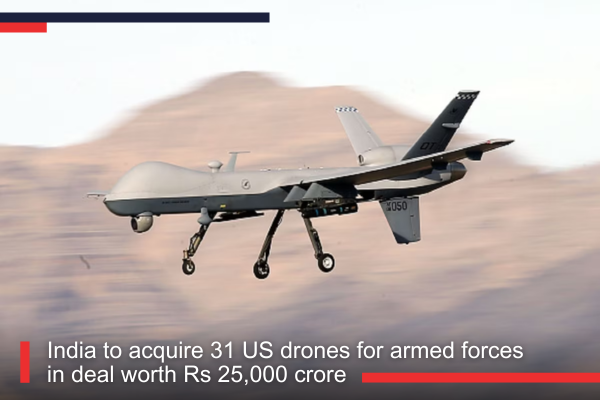
New Delhi: India is set to submit a letter of request (LoR) to the US government this week to initiate the procurement of 31 MQ-9B remotely piloted aircraft systems (RPAS) under the foreign military sales (FMS) program.
The LoR will outline the requirements of the three services, specify the equipment sought, and propose the terms of procurement. The deal is estimated to be valued at $3.07 billion (over ₹25,000 crore).
The acceptance of necessity (AoN) for the purchase of the MQ-9B General Atomics high-altitude long endurance (HALE) drones was granted by India’s defence acquisitions council (DAC) on June 15. This marked the first step towards acquiring military hardware.
The United States will respond to the LoR with a letter of offer and acceptance (LoA) after a formal congressional notification. Following this, India will engage in negotiations with the US, considering the price and terms offered, before finalising the deal through the contract negotiation committee and seeking approval from the cabinet committee on security led by the Prime Minister.
During PM Modi’s state visit to the US on June 22, a joint statement by the two nations mentioned the proposed deal. The statement highlighted that General Atomics would establish a comprehensive global maintenance, repair and overhaul (MRO) facility in India, supporting the country’s long-term goal of enhancing indigenous defence capabilities.
While questions have been raised by the Congress party regarding pricing, acquisition procedures, technology transfer, and self-reliance in defence, government officials have defended the deal, emphasising that India aims to negotiate a competitive agreement with the US that ensures transparency and facilitates the transfer of critical technologies.
The number of drones to be purchased is based on the operational requirements of the armed forces.
Out of the 31 drones, 15 will be allocated to the navy and eight each to the Indian Army and the Indian Air Force. Ten drones are expected to be procured as ready-made units while the remaining 21 will be assembled in India.
The estimated cost of the deal includes weapons, sensors, ground control stations, logistics support and other necessary equipment.
India will also seek a higher element of technology transfer, aiming to double the current offering from 8-9% to 15-20%. The versatile MQ-9B platform is capable of striking targets, conducting intelligence, surveillance, and reconnaissance (ISR) operations, and fulfilling roles such as electronic warfare, defensive counter air, and airborne early warning.
The decision on the number of drones to be acquired was based on a scientific study that considered the requirements of the three services and the extensive land and maritime borders of India.



















Discussion about this post