










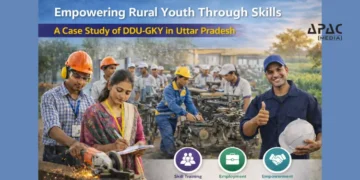













The Deen Dayal Upadhyaya Grameen Kaushalya Yojana was launched on 25 September 2014 by the Ministry of Rural Development. Widely known as DDU-GKY, it was designed to address one of rural India’s biggest challenges: sustainable livelihoods for underprivileged youth.
The scheme focuses exclusively on young people between 15 and 35 years of age from economically weaker rural families. It carries a clear dual mandate: To diversify the income sources of rural poor households and to respond to the career aspirations of rural youth.
While the scheme follows a common national framework, its impact depends largely on how states adapt and implement it. Uttar Pradesh, with its large rural population and need for formal employment opportunities for the youth, offers a useful case study of how the scheme is tailored to meet local needs.
DDU-GKY in Uttar Pradesh: Broader Scheme Tailored to Local Needs
In Uttar Pradesh, the scheme is being implemented through the Uttar Pradesh Skill Development Mission (UPSDM). The state follows the national framework while adapting it to local needs and scale. Training under DDU-GKY in Uttar Pradesh is fully residential, free of cost, and designed to directly link candidates with livelihood opportunities.
The scheme offers courses with a minimum duration of 576 hours, extendable up to 2,304 hours depending on the trade. Funding follows a 60:40 pattern, with the Central Government contributing 60 percent and the State Government 40 percent.
Inclusive Targets and Social Focus
Uttar Pradesh has adopted the scheme’s strong inclusion framework. Training targets are clearly defined, with 45 percent seats earmarked for Scheduled Castes, 1 percent for Scheduled Tribes, 33 percent for women, and 17 percent for minorities. This ensures that skill development reaches communities that traditionally face barriers to formal employment.
Attendance and participation are closely monitored through an Aadhaar-enabled biometric attendance system, strengthening transparency and accountability across training centres.
Enrollment requires document verification, including proof of age and household eligibility, ensuring that benefits reach the intended groups.
A Structured Governance Model
The state has put in place a multi-tier governance structure for effective implementation. At the top is the Principal Secretary of Vocational Education, Skill Development and Entrepreneurship, who chairs the program. The Mission Director and Chief Operating Officer of UPSDM oversee planning and execution. At the field level, State, District and block program managers coordinate training, mobilization and monitoring.
This structure allows the scheme to function efficiently across districts while maintaining consistent standards.
State-Level Innovations Powering DDU-GKY in Uttar Pradesh
Uttar Pradesh has introduced several implementation-level innovations to strengthen DDU-GKY delivery and outcomes. These include:
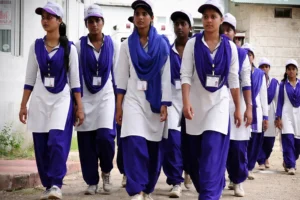
Migration Support Centre: The Migration Support Centre addresses key challenges faced by rural youth who move out for work. It focuses on providing social security and improving social acceptance for migrant workers while supporting stable livelihood generation. The initiative also helps candidates understand the geographical and demographic conditions of destination areas, reducing uncertainty around migration. By addressing fears of exploitation and lack of information, the centre aims to make migration safer, more informed, and more sustainable for trained youth.
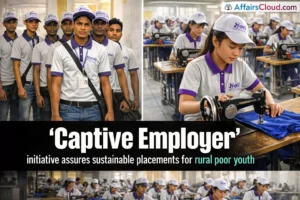
Captive Employer Impanelment: The Captive Employer Impanelment initiative strengthens placement outcomes by directly linking training with assured employment. Under this model, the state empanels select employers across sectors such as manufacturing, textiles, food processing, solar energy, infrastructure, and services. This approach reduces placement risk, ensures industry-relevant skills, and supports sustainable employment for rural youth by aligning training delivery with actual workforce demand.

Kaushal Disha Portal: The Kaushal Disha Portal is a digital learning initiative designed to support skill development for underprivileged youth. It functions as a learning management system that offers structured video lecture series for top job roles, along with online assignments and tests. The portal also features a chatbot to help learners resolve queries and access support easily. Through online assessments and digital certification, Kaushal Disha enables end-to-end learning, evaluation, and certification on a single platform, making skill training more accessible and flexible.
Building Livelihoods Across Rural Uttar Pradesh
Through DDU-GKY, the Uttar Pradesh government is creating a structured pathway from rural poverty to skilled employment. By combining inclusion, scale, industry linkage and strong governance, the state’s implementation reflects how skill development can translate into real economic mobility for rural youth.










Discussion about this post