





























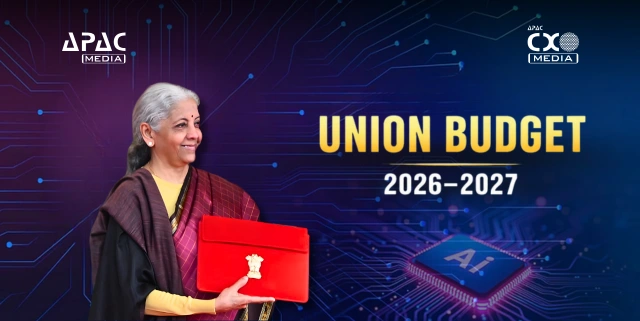
New Delhi: Union Finance Minister Nirmala Sitharaman on 1 February outlined an ambitious technology-led vision in the Union Budget 2026–27, placing artificial intelligence and data centre infrastructure at the heart of India’s development roadmap.
Emphasising that the 21st century is fundamentally technology-driven, Sitharaman said the adoption of advanced technologies must benefit all sections of society, including farmers, women in STEM, youth seeking new skills and Divyangjan aspiring for greater access to opportunities. She highlighted that the government has already taken multiple steps to support emerging technologies through initiatives such as the AI Mission, National Quantum Mission, the Anusandhan National Research Fund, and the Research, Development and Innovation Fund.
A key announcement was the launch of Bharat-VISTAAR (Virtually Integrated System to Access Agricultural Resources), a multilingual AI-powered platform designed to integrate AgriStack portals with the Indian Council of Agricultural Research (ICAR) package on agricultural practices. The system will use AI to provide customised advisory support to farmers, helping improve productivity, enable better decision-making and reduce risks in farming operations.
The Budget also underscored the use of AI for social inclusion. Under the proposed Divyang Sahara Yojana, the government will support the Artificial Limbs Manufacturing Corporation of India (ALIMCO) to scale up production of assistive devices, invest in research and development, and integrate AI into device design and delivery. In addition, PM Divyasha Kendras will be strengthened and Assistive Technology Marts will be set up as modern retail-style centres where Divyangjan and senior citizens can view, try and purchase assistive products.
In the logistics and trade ecosystem, Sitharaman announced a phased expansion of non-intrusive scanning using advanced imaging and AI-based risk assessment technologies. The objective is to eventually scan every container across all major ports, enhancing security and efficiency in cargo movement.
To support the growing demand for digital and AI infrastructure, the finance minister proposed a major tax incentive for data centres. Recognising data centres as critical infrastructure, the government will provide a tax holiday till 2047 to any foreign company that provides services to global customers by procuring data centre services in India. However, services provided to Indian users must be routed through an Indian reseller entity and taxed accordingly.
Additionally, a safe harbour of 15 per cent will be provided to resident entities offering data centre services to related foreign companies that deliver cloud services outside India. The same 15 per cent safe harbour on cost will apply where the company providing data centre services from India is a related entity, a move aimed at offering tax certainty and encouraging large-scale investments.
Manoj Kumar Singh, Director General of the Digital Infrastructure Providers Association (DIPA): “Union Budget 2026 delivers a transformative vision for India’s digital future. The tax holiday until 2047 for cloud providers leveraging Indian data centres is bold policy-making that positions us as a global hub while advancing our $3 trillion digital economy ambition. What’s truly significant is recognizing digital infrastructure as the great enabler. Robust telecom networks and data centres don’t serve one sector—they power fintech innovations, telemedicine reaching villages, smart manufacturing, AI research, and digital governance. When we strengthen this foundation, we catalyze growth across every economic horizon.”
Sudhir Kunder, CBO of DE-CIX India: “The Budget 2026 tax holiday for global cloud providers using India-based data centres is a decisive policy move that positions India as a long-term digital infrastructure and AI growth hub. As hyperscalers expand, the real differentiator will be resilient, carrier-neutral interconnection that enables low-latency access, ecosystem depth, and scalable digital economies.”
Amit Kumar Tyagi, CEO, TrueReach AI: “The Union Budget 2026 is a clarion call for the ‘Intelligence-First’ era. By proposing a tax holiday until 2047 for cloud services using Indian data centres and utilising the Ra 10,300 crore IndiaAI Mission to provide compute at a subsidised rate, the government has eliminated the cost barriers to high-end innovation. At TrueReach AI, we are particularly energised by the Economic Survey’s shift toward a bottom-up, sector-specific AI strategy. This aligns perfectly with our ‘Entropy’ platform, which already automates 90 per cent of the SDLC. With the government targeting a 10 per cent share of global services by 2047, we are no longer just an outsourcing hub; we are becoming an ‘AI Factory’ hub. The FM’s focus on Sovereign LMMs and the 38,000-GPU strong compute base ensures that Indian startups can now build production-grade, autonomous software 10x faster, allowing us to take ‘Made in India’ intelligence to the global stage with unprecedented scale.”
Anand Chandra, Co-founder & Executive Director, Arya.ag: “Bharat Vistar brings the promise of making agri-advisory more intelligent, timely, and accessible at the farmgate. By integrating AI with AgriStack and ICAR advisories in multiple languages, it can support better decisions on crops, inputs, and markets, especially for smallholder and first-generation women farmers. The Rural Women-Led Enterprises initiative, building on the Lakhpati Didi programme, takes this further by enabling the shift from subsistence livelihoods to ownership. In our experience, such enterprises succeed when they’re deeply embedded in local agri-value chains, with access to working capital, market linkages, and autonomy over key decisions. Women-owned agribusinesses often reinvest locally, strengthening household incomes and creating resilient micro-economies. As AgriStack integration deepens, these enterprises can also build digital footprints, unlocking access to formal finance, input systems, and structured trade. Importantly, many women-led groups are already leading the adoption of sustainable and climate-resilient practices. Strengthening them through enterprise support will generate both economic and environmental dividends. The Budget lays strong groundwork; execution will depend on how these initiatives reach real farms, in real time.”
Deepak Gupta, Co-Founder, Style Lounge: “Budget 2026 is basically telling us one thing: India wants to power the AI era, not just participate in it. When you pair ~7 per cent economic growth with a Rs 12.2 lakh crore public capex push and a tax holiday till 2047 for global cloud and data-center players using India infrastructure, it’s a clear bet on compute sovereignty. AI is only as strong as the compute behind it. Data centres are the new industrial corridors, except they move intelligence, not cargo. If India builds serious data-center capacity and talent, our future exports won’t just be services, but AI outcomes delivered from India to the world. The countries that own compute will shape the models and the ones shaping models will shape the economy.”
Bruce Keith, CEO & Co-Founder, InvestorAi: The ongoing fiscal discipline and general move towards tax harmonisation is welcome. Adding more heft and focus on education in a world where AI is changing the rules also makes sense. Perhaps the biggest surprise to me was the increase in Securities Transaction Tax (STT) on futures and options premiums by 150 per cent and 50 per cent, respectively.
The Government doesn’t like that 90 per cent+ people lose money in F&O so have chosen to make it more expensive. In my view, this is the wrong lever to this problem. Better to look at education and AI rather than risk collateral damage from a reduction in big volume players, causing liquidity to shrink. The overall market needs this to function.
Rohit Kumar, Founding Partner at the public policy firm The Quantum Hub (TQH): “The Budget clearly prioritises building domestic capability and reducing strategic dependencies, while positioning AI as a governance and productivity multiplier. The focus on compute, semiconductors, and data infrastructure is directionally right and the taxation measures – tax holidays for investments in data centres, customs duty exemptions for capital goods for nuclear power and critical minerals, and expanded safe harbour provisions – are especially promising. Together, these signal a shift towards a more trust-based regulatory regime, where the government places greater faith in businesses rather than defaulting to bad faith assumptions. If implemented well, this approach could reduce litigation, improve investor confidence, and mark a meaningful change in how the state engages with business – ultimately supporting stronger economic growth. Having said that, the Budget stops short of addressing harder questions around sustained R&D funding, private-sector innovation incentives, and long-term access to frontier AI capabilities.”
Keshava Murthy, CEO & Co-founder, Matters.AI: “Budget 2026 clearly signals the government’s intent to mainstream AI across governance, education, and agriculture—through the AI Mission, the Education-to-Employment Standing Committee, and platforms like Bharat-VISTAAR. As AI moves from experimentation into everyday workflows across public systems, enterprises will mirror this adoption internally. That shift brings a new challenge: organisations must gain visibility into how AI systems interact with sensitive data. The next phase of AI adoption will be defined not just by capability, but by oversight.”
The broader roadmap outlined in the Budget focuses on building cutting-edge technologies, particularly AI applications, with initiatives such as Bharat-VISTAAR serving as flagship examples of how AI will be integrated into governance, agriculture and public service delivery. Together, the measures signal a strong push to position India as a global hub for AI innovation and data centre-led digital infrastructure.













Discussion about this post