

























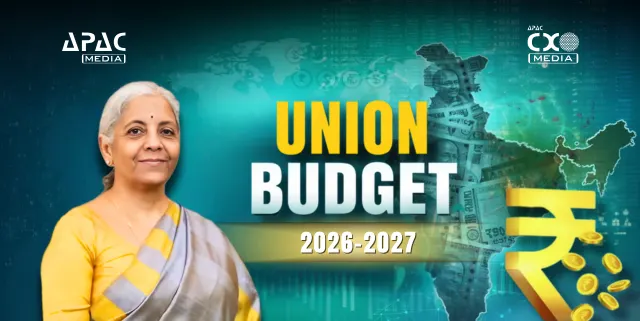
New Delhi: Finance Minister Nirmala Sitharaman on Saturday said the Union Budget 2026–27 is driven by ‘Yuvashakti’ and anchored around three ‘Kartavyas’, accelerating growth, fulfilling aspirations, and ensuring Sabka Saath, Sabka Vikas. With a total outlay of Rs 53.5 lakh crore, the Budget combines fiscal consolidation with targeted reforms across taxation, infrastructure, industry, social sectors and strategic manufacturing.
On the taxation front, Sitharaman maintained the status quo for individual taxpayers, announcing no changes in personal income tax rates. The New Income Tax Act, 2025, will come into effect from 1 April, with detailed rules and forms to be notified shortly. The ITR filing deadline for non-audit business cases and trusts has been extended to August 31, while individuals filing ITR-1 and ITR-2 will continue to have 31 July as the deadline. The window for filing revised returns has been extended till 31 March, subject to a nominal fee.
Abhinav Saxena, Founding Partner at Saxenas And Kumar Law Chambers LLP: “The Union Budget 2026 is a definitive step towards de-clogging India’s legal and regulatory arteries. We specifically welcome the proposal to implement a comprehensive New Income Tax Act to replace the six-decade-old law. For the legal fraternity and our corporate clients, this simplification is a long-awaited reform that will drastically reduce interpretation disputes and compliance friction. Furthermore, the focus on digitising NCLT tribunals and the introduction of a Customs Amnesty Scheme signal a clear shift towards a Trust-Based governance model. By smoothing out the insolvency process and reducing legacy tax litigation, the Government is allowing firms to focus on value creation rather than courtroom battles. For startups and MSMEs, this Ease of Doing Business is the most valuable capital of all.”
Several changes were announced in TDS and TCS rules. TCS on overseas tour packages has been cut to 2 per cent, while TCS on overseas education and medical expenses under the Liberalised Remittance Scheme has also been reduced to 2 per cent. Interest awarded by Motor Accident Claims Tribunals will now be fully exempt from income tax. TCS on goods has been rationalised, with alcoholic liquor, scrap and mineral products taxed at 2 per cent, and TCS on tendu leaves reduced from 5 per cent to 2 per cent.
For capital markets, the Budget delivered a surprise hike in Securities Transaction Tax. STT on futures has been increased from 0.02 per cent to 0.05 per cent, while STT on options premium has been raised from 0.10 per cent to 0.15 per cent. However, there is no change in short-term or long-term capital gains tax rates.
For non-resident Indians, the finance minister announced that TDS will be deducted on the sale of immovable property by NRIs. A foreign investment disclosure scheme has been introduced, and Persons of Indian Origin have been permitted to invest in equity instruments of listed Indian companies through the Portfolio Investment Scheme.
Bruce Keith, CEO & Co-Founder, InvestorAi: “The ongoing fiscal discipline and general move towards tax harmonisation is welcome. Adding more heft and focus on education in a world where AI is changing the rules also makes sense. Perhaps the biggest surprise to me was the increase in Securities Transaction Tax (STT) on futures and options premium by 150 per cent and 50 per cent, respectively. The Government doesn’t like that 90 per cent+ people lose money in F&O, so have chosen to make it more expensive. In my view, this is the wrong lever for this problem. Better to look at education and AI rather than risk collateral damage from a reduction in big volume players, causing liquidity to shrink. The overall market needs this to function.”
Infrastructure and railways featured prominently, with Sitharaman proposing seven high-speed rail corridors and one dedicated freight corridor. The high-speed rail network will connect major financial hubs, technology centres, manufacturing clusters and emerging cities, including Mumbai-Pune, Pune-Hyderabad, Hyderabad-Bengaluru, Hyderabad-Chennai, Chennai-Bengaluru, Delhi-Varanasi and Varanasi-Siliguri. A new freight corridor has been announced for Dankuni in West Bengal and Surat in Gujarat. The Budget also proposes to operationalise 20 new waterways and launch a Coastal Cargo Promotion Scheme to double the modal share by 2047.
In education, the government announced the establishment of a girls’ hostel in every district. Support will be extended to the Indian Institute of Creative Technologies, Mumbai, to set up content labs in 15,000 secondary schools. A new National Institute of Design will be established in eastern India through a challenge-based route, and states will be supported in developing five university townships near major industrial and logistics corridors.
Healthcare announcements included the exemption of basic customs duty on 17 cancer-related drugs and medicines. The government will strengthen emergency and trauma care facilities nationwide by establishing centres at district hospitals. Plans were also announced to set up NIMHANS 2.0, a premier mental health institute in North India. Additionally, seven more rare diseases will be added to the list eligible for exemption from import duty on personal imports of drugs, medicines and special medical foods.
On strategic manufacturing, Sitharaman announced the launch of ISM 2.0 with an outlay of Rs 40,000 crore to deepen India’s semiconductor ecosystem. Rare earth corridors will be developed in Kerala, Tamil Nadu, Odisha and Andhra Pradesh to boost domestic capabilities in critical minerals.
For the industry, the Budget proposes a tax holiday for foreign companies offering cloud services using data centres located in India, with a condition that services to Indian customers must be routed through Indian reseller entities. The outlay for electronics manufacturing will be increased to Rs 40,000 crore in FY27. The government also announced a Rs 10,000 crore investment in biopharma over the next five years and proposed a Rs 10,000 crore MSME Growth Fund to create future industrial champions. Trust-based customs systems will be strengthened, with advance ruling validity extended to five years. A high-level committee will be set up to raise the services sector’s contribution to 10 per cent by 2047. The timeline for Advanced Pricing Agreements has been reduced to two years, with a possible six-month extension. The Minimum Alternate Tax rate has been cut to 14 per cent and made final, while the safe harbour threshold for IT services has been raised to Rs 2,000 crore.
Naman Pushp, Founder & CEO, Airbound: “This Budget sends a clear signal that India wants to build and own emerging technologies, not just adopt them. The continued emphasis on deep-tech R&D through national missions, along with long-term innovation funding, is an important step toward backing hard, frontier problems that take years to solve. What stands out is the system-level approach. A horizontal push on manufacturing depth, duty rationalisation across critical inputs, stronger MSME liquidity, and sustained public capex together improve the base conditions required to build complex hardware in India. These may not be sector-specific yet, but they strengthen the industrial foundation that advanced technologies depend on. At the same time, leadership in sectors like autonomous aviation and drone-led logistics will ultimately depend on how quickly this intent translates into execution. Particularly sustained R&D funding, targeted capex support for advanced manufacturing, specialised testing infrastructure, and access to global talent. If those pieces come together, India has a real opportunity to move from participating in these sectors to defining global standards over the coming decade.”
On the macroeconomic front, the finance minister pegged the fiscal deficit for 2026-27 at 4.3 per cent of GDP and said the government aims to bring down the debt-to-GDP ratio to 55.6 in FY27. Capital expenditure has been raised to Rs 12.2 lakh crore, while Rs 1.4 lakh crore will be devolved to states as tax share. Net tax receipts are estimated at Rs 28.7 lakh crore, and gross market borrowings at Rs 17.2 lakh crore. Sitharaman said over 350 reforms have already been rolled out, keeping the “reform express” firmly on track.
In agriculture, the Budget announced coconut and cashew promotion schemes, rejuvenation of old orchards, and high-density cultivation of walnuts, almonds and pine nuts. An integrated fisheries development programme covering 500 reservoirs and Amrit Sarovars was announced. Fish caught in India’s EEZ or on the high seas will be duty-free even if landed at foreign ports. Sandalwood cultivation and processing will be strengthened, and dividend income for the notified national cooperative federations will be exempted for three years.
Tourism also received a significant push, with trekking and hiking promotion planned in Jammu and Kashmir, Uttarakhand, Araku Valley and Pudigai Malai. Wildlife tourism, birdwatching, turtle nesting sites and Buddhist heritage trails will be developed. India will host the first Global Big Cat Summit, while 15 archaeological sites, including Sarnath and Hastinapur, will be upgraded. A National Institute of Hospitality will be established, and 10,000 tourist guides will be trained through a 12-week hybrid programme.
Shwetank Singh, Executive Director, Chalet Hotels Limited: “As we approach the 2026 Budget, India’s hospitality sector waits with measured optimism. We’ve created 46.5 million jobs and are projected to support 64 million by 2035, yet do not get classified as infrastructure, which is a looming constraint on scale. The 2025-26 Union Budget extended infrastructure status to hotels in 50 select destinations, but the sector needs comprehensive recognition. Infrastructure classification unlocks soft financing, lower utility tariffs and rationalised property taxes, support that is routinely granted to highways and ports, but withheld from hotels despite equivalent capital intensity. Equally critical is bringing tourism into the concurrent list. Policy coordination between the centre and states has long remained fragmented. To ensure seamless implementation across diverse destinations, tourism, and by extension, hospitality requires constitutional alignment within shared legislative space. This will further help in the holistic development of the destination, giving a seamless experience to the traveller.
On jobs and skills, Sitharaman announced a Digital Knowledge Grid to create employment opportunities for researchers and historians, the She-Mark scheme to support women entrepreneurs, and the formation of an Education-to-Employment-and-Enterprises (E2E) Standard Committee.
Sanket Atal, Senior Vice President, Engineering and Country Head, India, OpenText: “The budget’s focus on the services sector is a welcome recognition of the critical role skilled talent plays in India’s long-term growth. The proposal to set up a high-powered Education to Employment and Enterprises Standing Committee is a practical step towards strengthening the link between education outcomes and industry requirements. Greater emphasis on market-relevant skills, particularly in emerging areas such as AI will be critical. Additionally, while India has a large workforce, gaps remain between academic training and the skills needed to develop, deploy, and manage AI-driven and cloud-based systems at scale. Addressing these gaps through closer industry-education collaboration, applied learning programmes, and continuous reskilling will be key to improving workforce readiness. Securing a ten percent share of the global services market by 2047 will depend on how effectively education systems, industry need,s and export priorities are aligned. A coordinated approach to skill development that meets global standards can enhance employability, strengthen competitiveness, and deepen India’s role in global services value chains.”
Defence allocations were raised sharply to Rs 7.85 lakh crore for 2026-27, up from Rs 6.81 lakh crore in the previous year. Capital outlay stands at Rs 2.19 lakh crore, while revenue expenditure is estimated at Rs 5.54 lakh crore, including Rs 1.71 lakh crore for pensions. Under capital expenditure, Rs 63,733 crore has been allocated for aircraft and aero engines, and Rs 25,023 crore for strengthening the naval fleet. The Budget also provides customs duty relief by exempting basic customs duty on components and raw materials required for manufacturing and maintaining civilian and defence aircraft, including those used in MRO operations.
Krishanu Acharya, Co-Founder & CEO, Suhora Technologies: “The Union Budget 2026 builds on the groundwork laid over the last few years by backing specific enablers for technology and space-led growth. Continued support for emerging technologies through initiatives like the IndiaAI Mission and the Rs 10,000 crore SME Growth Fund for startups and MSMEs strengthens the overall innovation ecosystem. The 15% increase in the defence budget to Rs 7.85 lakh crore is a particularly strong signal for the space sector, as defence remains one of the largest and most strategic users of space-based capabilities. We are hopeful that the increased allocation in defence will accelerate greater adoption of satellite data analytics for ISR, terrain surveillance and maritime domain awareness to not only enhance operational readiness but also create sustained demand for indigenous space technologies. This, in turn, will help the domestic space ecosystem mature faster, from upstream satellite capabilities to downstream analytics and applications. For companies like Suhora Technologies, working across space, geospatial and data-driven domains, these measures indirectly support product innovation, talent creation and long-term collaboration with defence stakeholders, enabling Indian technology firms to scale and engage more meaningfully with global markets.”
Overall, the Union Budget 2026-27 reflects a calibrated approach, prioritising growth and infrastructure while maintaining fiscal discipline and pushing reforms across sectors critical to India’s long-term economic transformation.












Discussion about this post