

















New Delhi, September 23 (APAC Media): Ayushman Bharat is one of the Centre’s flagship healthcare initiatives, designed to expand access to affordable healthcare while providing financial protection against major medical expenses.
Launched in 2018, the programme has since expanded across hospital care, primary healthcare, digital health and health infrastructure.
But what exactly is Ayushman Bharat, who can benefit from it and what does the Rs 5 lakh health cover actually mean?
What Is Ayushman Bharat?
Ayushman Bharat is an umbrella healthcare initiative built around multiple components rather than a single scheme.
Its key pillars include:
- Ayushman Bharat PM-JAY for financial protection during hospitalisation
- Ayushman Arogya Mandirs for comprehensive primary healthcare
- Ayushman Bharat Digital Mission (ABDM) for digital health infrastructure
- PM-Ayushman Bharat Health Infrastructure Mission (PM-ABHIM) for strengthening public health infrastructure
What Is PM-JAY?
The Ayushman Bharat Pradhan Mantri Jan Arogya Yojana (AB PM-JAY) is the financial protection component of Ayushman Bharat.
It provides eligible families with cashless hospitalisation cover of up to Rs 5 lakh per family per year for secondary and tertiary care at empanelled public and private hospitals. The scheme has no restriction on family size, age or gender, while pre-existing diseases are covered from the first day.
The cover includes expenses such as medicines, diagnostics, hospital accommodation, intensive care, surgery and other treatment-related costs, along with defined pre- and post-hospitalisation expenses.
Who Is Eligible?
PM-JAY was originally designed to cover poor and vulnerable households identified largely through deprivation and occupational criteria under the Socio-Economic Caste Census (SECC) 2011.
The scheme has since been expanded to include additional groups. In 2024, the government approved coverage for all citizens aged 70 years and above, irrespective of income, under PM-JAY.
Accredited Social Health Activists, Anganwadi workers and helpers have also been brought under the scheme.
How Does the Rs 5 Lakh Cover Work?
The Rs 5 lakh benefit is a family-floater cover, meaning the amount can be used by one or more eligible members of the family, depending on their treatment needs.
There is also national portability, allowing eligible beneficiaries to access cashless treatment at empanelled hospitals across India.
What Are Ayushman Arogya Mandirs?
PM-JAY focuses mainly on hospitalisation, while Ayushman Arogya Mandirs bring primary healthcare closer to communities.
These centres provide services covering preventive, promotive, curative, rehabilitative and palliative care. Their services include maternal and child healthcare, screening for non-communicable diseases, mental health services, teleconsultation, essential medicines and diagnostics.
More than 1.87 lakh Ayushman Arogya Mandirs were functional as of September 2026, according to the official portal.
Ayushman Bharat After 8 Years: Key Numbers
As the scheme completes eight years, the government says:
- More than 48.51 crore people held Ayushman cards as of September 21, 2026.
- PM-JAY had funded 13.25 crore hospital admissions worth around Rs 2.03 lakh crore as of August 31, 2026.
- The treatment network had more than 38,000 empanelled public and private hospitals.
- Ayushman Arogya Mandirs have recorded more than 540 crore visits.
What Has Changed Over the Years?
The programme has expanded beyond hospital insurance into a broader healthcare ecosystem.
ABDM is building the digital health layer through Ayushman Bharat Health Accounts (ABHAs), allowing health records to be digitally linked and shared with consent.
Meanwhile, PM-ABHIM focuses on strengthening health infrastructure and building capacity across primary, secondary and tertiary levels.
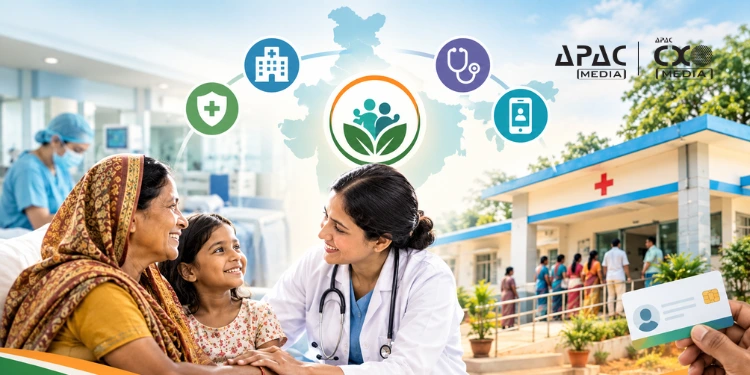
In simple terms, Ayushman Bharat works across the healthcare chain: Ayushman Arogya Mandirs focus on primary care, PM-JAY provides financial protection for eligible hospitalisation, ABDM builds the digital health backbone and PM-ABHIM strengthens health infrastructure.
Together, these initiatives can take India towards universal health coverage, while also reducing the financial burden of medical treatment on Indian households.
Also Read: