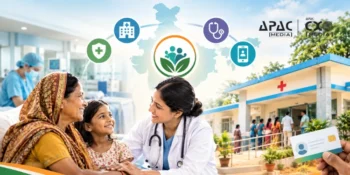













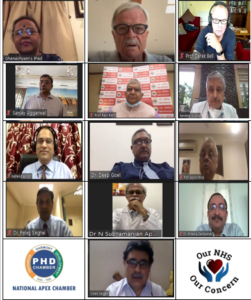
New Delhi: During the ‘Healthconomics Joint Stakeholders’ Roundtable of India and UK on the Emerging Landscape of Healthcare Delivery in Wake of Covid-19” recently organised by PHD Chamber virtually, Prof. Randeep Guleria, Director, AIIMS Delhi has said that frugal Innovation, Digital Health, Data Science, Community Mobilisation and Surveillance systems at the district level is the way forward for India to handle Pandemics and manage health care. The experts from UK like Prof Sir Malcolm Grant and Prof Derek Bell also dwelled on Prevention and Workforce skilling and management as key for Healthconomics.
Prof. Randeep Guleria shared the ongoing challenges the country is facing, while fighting with COVID-19 situation. He mentioned that earlier we could only manage 10,000 tests per day for Covid and now we have more than 1200 labs for Covid testing and performing more than 3.5 lac tests every day.
He also mentioned about their research paper with Department of Biotechnology regarding the recycling of PPE kit as to reduce the import dependency. Prof. Guleria mentioned about the most important facility started by AIIMS, New Delhi as “Contact” which is tele-consultation application providing 24*7 online audio video consultation to the patients at large.
Prof. Ravi Kant, Director, AIIMS, Rishikesh mentioned about the focus on the prevention as it is better than cure. He has also mentioned to maximise the use of Tele Health technology to cater more population. Prof. Ravikant talked about the preventive care by Yoga & Ayurveda while focusing on schooling by water purity, nutrition orientation and vaccine.
He has mentioned that tertiary care requires more money which can be only reduced by focusing on the primary care. He also said that to increase the standards of private medical schools and emphasized on the school education to play a role in hygiene and nutrition.
Prof. Ravikant also highlighted the need of health insurance and insisted that everyone should be insured and emphasized on the role of Yoga for prevention and Ayurveda for the management of mild cases.
The hospital industry is expected to reach $132 bn by 2023 from $ 61.8 bn in 2017; growing at a CAGR of 16-17%. He has also mentioned that the best & qualified doctors India has, who are providing cost efficient treatment in India and Government initiatives like Ayushman Bharat and to allow FDI up to 100% under automatic route, India can also become a Healthcare Delivery hub of the world, said Sanjay Agarwal, Senior Vice President, PHDCCI & Chairman & CEO of Paramount Cables Group.
He further gave some specific suggestions regarding investment in hospital infrastructure, technology transfer and Investment in training and skilling of the medical professionals specially the paramedics, nurses, medical technicians & clinical trial experts.
The other eminent panellists present were Ruchi Ghanshyam, Ex High Commissioner of India to UK, Prof Sir Malcolm Grant, Ex-Chairman, NHS, UK, Prof Derek Bell, Chair, Acute Medicine, Imperial College, London, Mahendra Singh, Expert Member, Digital Health, AI in Health, Telemedicine & Innovation, WHO Geneva, Dr. Deep Goel, Senior Director & Robotic Gastrointestinal Surgeon, BLK Hospital, New Delhi, Dr. Shreeraj Deshpande, Chief Operating Officer, Future Generali India Insurance Company Limited, Prof. Bejon Misra, Founder, Partnership for Safe Medicines (PSM) India, Prof. Parag Singhal, Consultant Endocrinologist, UK, Dr. N. Subramanian, Chairman, Health Committee, PHDCCI & Director, Medical Services, Indraprastha Apollo Hospitals and Vivek Seigell, Principal Director, PHD Chamber.