


























New Delhi: State-owned telecom major Bharat Sanchar Nigam Limited (BSNL) has rolled out over 93,450 4G towers using India’s homegrown telecom stack, a major milestone in the country’s push for self-reliant digital infrastructure.
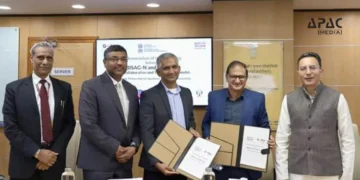
Union Telecom Minister Jyotiraditya Scindia announced the achievement during the curtain raiser for the India Mobile Congress (IMC) 2025.
“We are at 93,450 towers that have been installed. Still, a long way to go, but we are on track,” Scindia said, while highlighting the progress of BSNL’s 4G deployment.
He noted that the Ministry of Communications had reviewed the rollout earlier in the day.
The transition marks a key initiative under the Centre’s ‘Atmanirbhar Bharat’ mission, relying on a fully indigenous telecom stack developed in just 22 months.
This domestic stack brings together public and private sector stakeholders, which include C-DoT, BSNL, Tejas Networks and Tata Consultancy Services (TCS).
Union Minister Scindia said that with this, India joins a select group of countries (which are China, Finland, Sweden and South Korea) that possess their homegrown telecom technology stack.
It should be noted that under a nearly Rs 19,000 crore contract, the TCS-led consortium is setting up one lakh 4G sites for BSNL.
It was also reported earlier that TCS recently secured an advance purchase order worth Rs 2,903 crore to deploy 4G networks at 18,685 locations, with Tejas Networks contributing equipment worth around Rs 1,525 crore.
Union Minister Scindia stressed that India must move beyond deployment to designing and scaling telecom technologies domestically.
“We have to ensure that India becomes a hub for designing. So you have designing, solving and scaling from India,” he said.
Additionally, he states that the Bharat 6G Alliance is actively fostering collaboration across the public and private sectors for 6G research and development.
Furthermore, the minister noted that the next World Radio Communications Conference by the International Telecommunication Union (ITU), scheduled for 2027, will be crucial in defining 6G standards.
He then called on innovators and industry leaders to position India at the forefront of this next-generation technology.
Echoing the optimism, Neeraj Mittal, IAS, Secretary, Department of Telecommunications, stated that while India lagged in the 4G era, it has caught up with the world on 5G and is poised to lead in 6G.
“That is the promise and dream which all of us would like to see fulfilled,” he stated.
Meanwhile, Abhijit Kishore, Chairman of COAI and COO of Vodafone Idea, said the industry must collectively showcase its potential and make India a global playground for telecom innovation.












Discussion about this post