





























New Delhi: The National Assessment and Accreditation Council (NAAC) will replace traditional peer-review inspections with an AI-led accreditation model from August 2025, aiming to streamline quality checks in higher education.
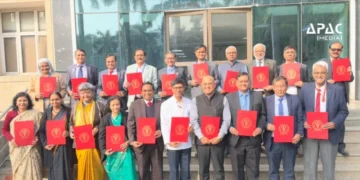
Announced by NAAC Chairman Prof. Anil Sahasrabudhe, the new system eliminates physical peer team visits for initial accreditation. The revised framework will instead use automated digital document verification, machine learning tools, and crowdsourced feedback from stakeholders. The shift comes amid criticism of delays, inconsistencies, and credibility issues in the existing manual assessment process.
These reforms follow the recommendations of a committee headed by former ISRO Chairman K. Radhakrishnan, constituted in 2022 to overhaul India’s higher education accreditation mechanism.
The upcoming system introduces a two-level accreditation model. Under the Basic Accreditation tier, institutions will be designated as either “Accredited” or “Not Accredited” based on a fixed set of indicators:
Universities: 55 indicators (Minimum score: 50%)
Autonomous Colleges: 50 indicators (Minimum score: 45%)
Affiliated Colleges: 40 indicators (Minimum score: 40%)
Institutions that qualify under the basic criteria can voluntarily pursue Maturity-Based Graded Accreditation, which ranges from Level 1 to Level 5. From Level 3 onwards, NAAC will reintroduce inspections in a hybrid (online + physical) format to curb data manipulation.
A notable feature of the new system is an AI-driven credibility score, assigned to institutions based on the accuracy of submitted data. Each institution begins with a baseline score of 0.5. The score adjusts through document verification by AI and validation from a rotating panel of 100+ stakeholders, including academics, industry experts, and NGO representatives.
Institutions found submitting false data will face a three-year disqualification from reapplying for accreditation.













Discussion about this post