













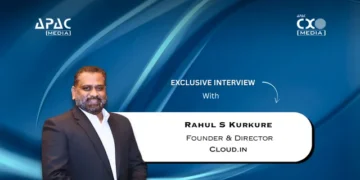






Cloud adoption is moving beyond basic infrastructure migration toward modernization, data platforms, security, governance, optimization and application transformation. At the same time, Rahul S Kurkure, Founder & Director, Cloud.in feels that GenAI is creating new requirements around data, security, model access, governance, cost management and integration with existing enterprise systems. In an exclusive conversation with Rajneesh De, Group Editor, APAC Media & CXO Media, Kurkure informs that this creates opportunities for Cloud.in across cloud modernization, managed cloud operations, FinOps, cybersecurity, AI and Generative AI adoption, and governance.
Cloud.in has evolved beyond traditional cloud services. What services and capabilities does Cloud.in offer enterprises today?
Cloud.in helps enterprises design, build, secure, operate and optimize their cloud and digital environments. Our core capabilities include cloud consulting and migration, managed cloud services, FinOps and cost optimization, cybersecurity and 24×7 monitoring, cloud governance, AI and Generative AI, and digital transformation.
Our approach is focused on the complete lifecycle of an enterprise workload rather than a single technology implementation. That means helping customers move to the cloud, modernize their environments, establish appropriate security and governance, optimize their infrastructure and operate it effectively after deployment.
AWS is a significant part of our technology ecosystem, supported by our capabilities across cloud, security, AI and managed services. We also work across other technology environments where customer requirements call for it.
The objective is straightforward: help customers get practical business value from technology without creating unnecessary complexity.
What are the key pillars of Cloud.in’s go-to-market strategy in India, and how are you differentiating the company in an increasingly competitive cloud market?
Our go-to-market strategy is built around a combination of cloud expertise, managed services, cybersecurity, AI and strong customer relationships.
We believe the enterprise market does not simply need another technology reseller. Customers need partners who can understand a business problem, architect the right solution, implement it and remain accountable for the environment after deployment.
Our differentiation comes from combining consulting and engineering with ongoing managed operations. We also focus on building repeatable capabilities and intellectual property around problems that we see repeatedly in the market.
We are particularly focused on areas where customers need practical outcomes—cloud modernization, cost optimization, security, managed operations and increasingly AI and Generative AI.
Our philosophy is to keep technology solutions practical. Complexity should be introduced when customer requirements justify it, not simply because the technology allows it.
Cloud.in recently achieved AWS Premier Tier Services Partner status. What does this recognition represent in terms of Cloud.in’s capabilities, investments and track record, and what does it enable the company to do for customers?
Achieving AWS Premier Tier Services Partner status is an important milestone for Cloud.in and reflects the capabilities we have built over many years around AWS.
For us, the significance goes beyond the designation itself. It reflects sustained investment in cloud skills, certifications, delivery capabilities, customer engagements and specialized AWS capabilities.
Reaching this level requires an organization to demonstrate technical expertise, customer experience and the ability to deliver AWS services at scale. It is therefore a useful external validation of the capabilities we have been building within Cloud.in.
For our customers, it gives them the confidence of working with an AWS partner that has demonstrated capabilities across multiple areas of cloud delivery.
We see the Premier designation as a milestone in our journey, rather than an endpoint. The focus remains on converting that capability into better customer outcomes.
What led Cloud.in to develop QPulse, and what problem were you trying to solve in the emerging quantum computing ecosystem?
The idea for QPulse came from a relatively simple business problem: as access to quantum computing becomes easier, organizations will increasingly need visibility into how those resources are being consumed.
With cloud-based quantum services, experimentation can involve multiple teams, users, workloads and consumption patterns. Organizations need to understand who is using the resources, what they are being used for, how much is being consumed and what the associated costs are.
QPulse was initially developed around Amazon Braket consumption tracking and governance. We saw an opportunity to build a platform that addresses the operational and governance layer around quantum computing rather than attempting to build quantum hardware or compete with quantum computing platforms.
QPulse is designed to provide visibility, monitoring, reporting, budgeting and governance capabilities around quantum workloads.
As the ecosystem develops, we believe this type of governance layer can become increasingly relevant as organizations move from individual experimentation toward more structured quantum initiatives.
How does Cloud.in help customers operate and protect mission-critical workloads across cloud environments?
Mission-critical workloads require more than infrastructure. They require continuous visibility, operational discipline, security and governance.
Cloud.in supports customers across this lifecycle through managed cloud operations, 24×7 monitoring, cybersecurity and SOC capabilities, cloud governance, FinOps, performance monitoring and operational automation.
Our teams work across areas such as infrastructure operations, security monitoring, incident management, cloud optimization and ongoing technical support. Where appropriate, we also apply AWS Well-Architected principles and other established operational practices.
Our approach is to combine people, processes and technology rather than relying on any one of them. Automation helps improve consistency and speed, while experienced engineering and operations teams remain important for situations that require judgement and intervention.
For customers, the objective is to create cloud environments that are operationally manageable, secure and economically sustainable as they grow.
How is Hostin Services investing in engineering talent, automation, cloud governance, cybersecurity and AI capabilities to support Cloud.in’s next phase of growth?
Our next phase is about building deeper capability rather than simply increasing headcount.
We continue to invest in engineering skills, cloud certifications, automation, cybersecurity and AI and Generative AI capabilities. At the same time, we are increasingly converting recurring customer problems into reusable engineering assets and intellectual property.
This is an important evolution for us. Our services business gives us direct exposure to real enterprise challenges. When we encounter a problem repeatedly, we ask whether it can be solved through automation, a reusable framework or eventually a product.
QPulse is one example of this approach. We are also developing capabilities around cloud governance, security, FinOps and AI that can be applied across customer environments.
Our objective is to combine strong engineering talent, automation and proprietary technology so that we can deliver better outcomes without proportionately increasing operational complexity.
How do you see enterprise cloud and AI adoption evolving in India over the next 2–3 years, and what areas is Cloud.in prioritizing as the market develops?
We expect cloud and AI to increasingly become interconnected rather than separate technology initiatives.
Cloud adoption is moving beyond basic infrastructure migration toward modernization, data platforms, security, governance, optimization and application transformation. At the same time, Generative AI is creating new requirements around data, security, model access, governance, cost management and integration with existing enterprise
systems.
For Cloud.in, this creates opportunities across several areas: cloud modernization, managed cloud operations, FinOps, cybersecurity, AI and Generative AI adoption, and governance.
We are particularly interested in helping customers move from AI experimentation toward practical enterprise use cases. That requires understanding the business problem, selecting an appropriate technology approach, establishing security and governance, and measuring the value created.
Rather than trying to predict exactly how the market will evolve, our approach is to stay close to customer requirements and continue investing in capabilities where we see sustained demand emerging.
Cloud.in has been developing platforms and intellectual property alongside its services business. How important is productization to Cloud.in’s long-term strategy?
Productization is becoming increasingly important to our long-term strategy.
Our services business gives us a useful advantage: we work closely with enterprises and see their technology challenges firsthand. When we encounter the same problem repeatedly, there is an opportunity to solve it more systematically through automation, frameworks or intellectual property.
The objective is not to turn every service into a product. Some problems are inherently customer-specific and require consulting and engineering expertise. But where a problem is common, repeatable and sufficiently well understood, productization can create value for both the customer and us.
QPulse is one example of this philosophy. It emerged from an operational requirement around quantum computing consumption and governance and is being developed as a dedicated technology platform.
Over time, we see Cloud.in operating across three complementary layers: technology services, managed operations and proprietary IP. The combination allows us to remain close to customers while also building solutions that can address recurring technology challenges at scale.