






















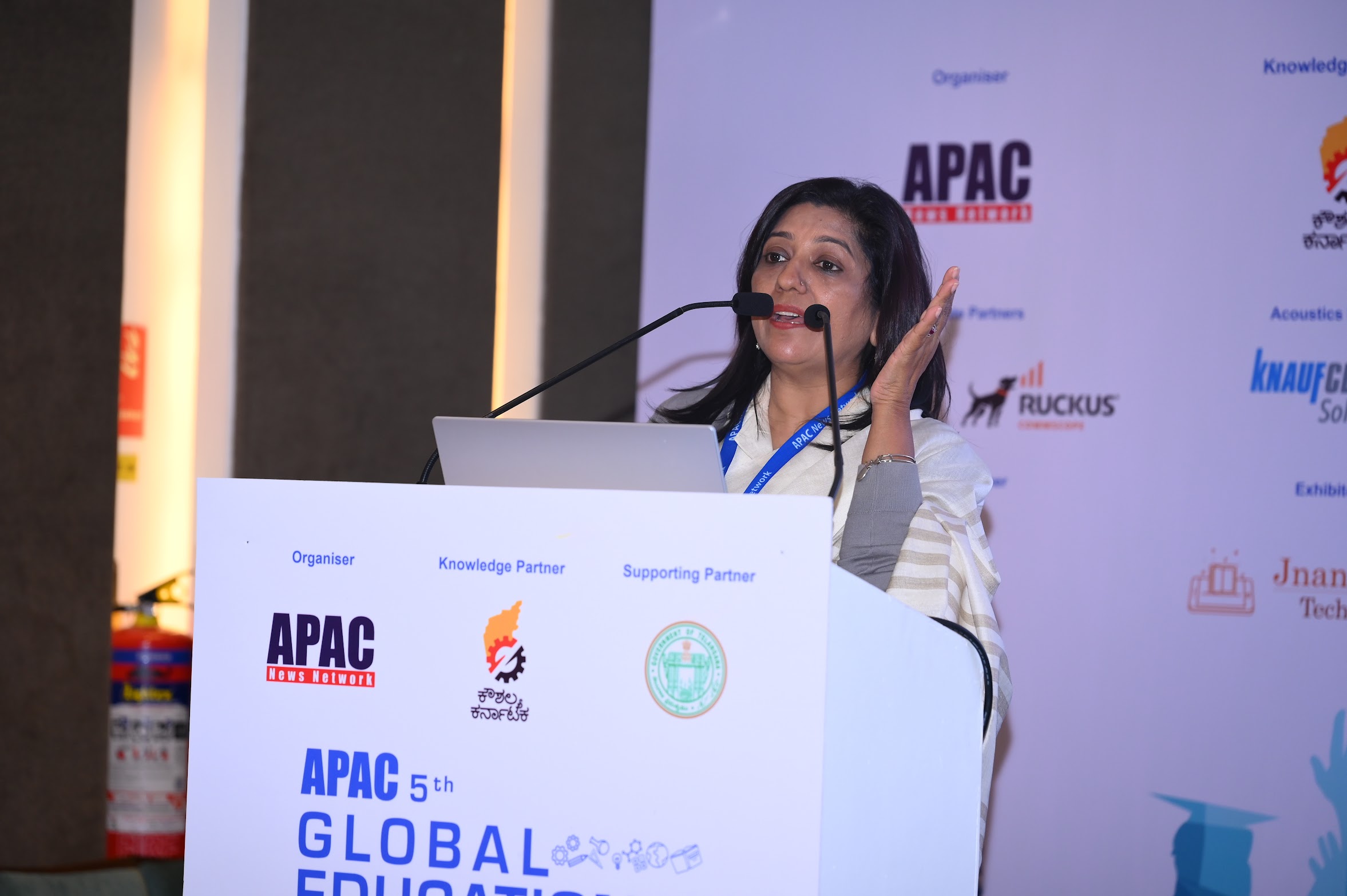
Bengaluru: Ensuring employable skilled workforce ready for the new age of digital innovation. That has been the endeavour of the Gujarat government while implementing various skill development & technical education courses. This was highlighted by IAS Anju Sharma, then Principal Secretary, current Additional Chief Secretary, Labour, Skill Development and Employment Department, Government of Gujarat, in her Keynote Address at APAC 5th Global Education & Skill Conclave, held in Bengaluru in February 2023. She talked about how the government of Gujarat is helping the youth to become capable of competing globally.
Sharma said, “For the next 10 years, 68 million jobs will be lost every year but 93 million new jobs will be created with new skill roles. Therefore, we need to redefine our education system in conjunction with technology and give students experiential education.”
Gujarat Model of Skill Development
The Gujarat model of skill development encompasses a range of initiatives and policies aimed at enhancing the employability of the youth of the state. Key components include the formulation of a Skill Development Policy, the establishment of Industrial Training Institutes (ITIs) offering vocational courses in various trades, the creation of Skill Development Centres catering to diverse sectors, and the fostering of industry partnerships to align training programs with market needs. Gujarat has also launched the “Kaushalya Vardhan Kendra” as part of its Skill Development Mission.
Mega and Mini ITIs
Sharma said, “We are working on Mega ITIs at the top offering skills certificates and Mini ITIs at the bottom where local youths in industrial zones are provided localised skills.”
Mega ITIs: Mega Industrial Training Institutes are large-scale training centres in India with extensive infrastructure, high student capacity, and a diverse range of vocational courses. They aim to provide high-quality training across multiple sectors.
Mini ITIs: Mini Industrial Training Institutes are smaller, more localised vocational training institutes with a limited scope of trades and facilities. They focus on specific skill areas, often in rural or smaller town settings, to promote skill development in local communities.
National Education Policy 2020 and Kaushalya Skill University
The National Education Policy 2020 aims to transform India’s education system to meet the needs of the 21st century and promote holistic development, critical thinking, creativity, and global competitiveness among students.
“National Education Policy (NEP) provides enough provisions to integrate skills with education. For example why we have come up with Kaushalya Skill University,” Sharma said. The University is committed to the principles of the NEP 2020, and aims to ‘promote skill based education, training and entrepreneurship development in an integrated manner and to offer education with Skills to every youth in the state.’
The University’s primary missions include addressing 21st-century skill gaps by providing skilling, re-skilling, and up-skilling opportunities to youth. It strives to meet global skilling standards, extend its reach and coverage through affiliated Skill Institutes such as Centre of Excellence (CoEs) and other institutions, and promote the integration of skill development with higher education by recognising academic credit earned from skill programs. Additionally, the University aims to facilitate research in emerging areas across various sectors within the state’s primary, secondary, and tertiary industries, with the goal of raising the overall skill level of the workforce.


Discussion about this post