

















New Delhi: Four days after N. Biren Singh resigned as Chief Minister of Manipur, the Central government announced the imposition of President’s Rule in the state, placing the Manipur legislative assembly under suspended animation. This decision comes after nearly one year and nine months of ethnic violence that has gripped the northeastern state since May 2023.
The notification from the Ministry of Home Affairs stated:
“I, Droupadi Murmu, President of India, have received a report from the Governor of the State of Manipur and after considering the report and other information received by me, I am satisfied that a situation has arisen in which the Government of that State cannot be carried on in accordance with the provisions of the Constitution of India (hereinafter referred to as the Constitution).”
“Now, therefore, in the exercise of the powers conferred by article 356 of the Constitution, and of all other powers enabling me on that behalf, I hereby proclaim that I – (a) assume to myself as President of India all functions of the Government of the State of Manipur and all powers vested in or exercisable by the Governor of the State; (b) declare that the powers of the Legislature of the said State shall be exercisable by or under the authority of Parliament.”

What Does President’s Rule Mean for Manipur?
With the imposition of President’s Rule, the Governor assumes control over the administration of the state, acting under the direct supervision of the Union Government. All executive functions of the Manipur state government are now vested in the President, while legislative powers are exercisable by or under the authority of Parliament.
In practical terms, bureaucrats and senior officials continue to manage the daily administrative affairs, while the Governor plays a key role in decision-making. However, major policy decisions and new developmental project approvals require the approval of the Central government.
Impact on Infrastructure and Developmental Projects
One of the key concerns arising from the President’s Rule is the status of ongoing infrastructure projects and whether new projects can be sanctioned during this period. The implications can be categorized as follows:
Road Projects: As of October 2024, the Ministry of Road Transport & Highways had approved 50 National Highway projects spanning 1,026 km. Of these, 44 projects covering 902 km are in the hill areas of Manipur. So far, eight projects totalling 125 km have been completed, while the remaining 36 projects, valued at Rs 12,000 crore and spanning 777 km, are in progress.
For the Annual Plan 2024-25, the Ministry has two new National Highway projects worth Rs 1,350 crore, covering a total distance of 90 km, located in the hills.
Under the Central Road and Infrastructure Fund (CRIF), the Ministry approves state road projects based on priorities set by the state government. Out of 111 proposed works in the priority list submitted by Manipur, 57 have been approved based on the Balance of Sanction (BoS) ratio. The current BoS ratio stands at 9.81, exceeding the permissible limit of 4 for hilly states.
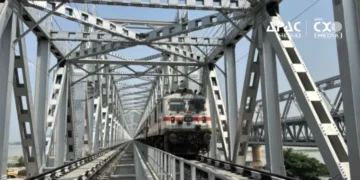
Railway Projects: The Jiribam-Imphal Railway Project is currently under construction and is expected to be completed by the end of 2025. A critical component of this project is the Noney Bridge, which, at a height of 141 meters, is poised to become the world’s tallest railway bridge. The 111 km railway line includes over 61 km of tunnels, 11 major bridges, and 137 minor bridges.
Other Developmental Projects: According to the Ministry of Development of North Eastern Region (DoNER), 121 ongoing projects are being implemented under schemes such as NESIDS-OTRI, Schemes of NEC, PM-DevINE, and NESIDS-ROADS. The total approved cost for these projects stands at Rs 1,806.36 crore. As of March 31, 2024, Rs 606.92 crore had been spent, with an additional Rs 146.98 crore spent between April 1, 2024, and December 31, 2024. In January 2025 alone, Rs 13.27 crore was spent, bringing total financial expenditure to Rs 767.16 crore.
Governance and Project Continuation Under President’s Rule
Alay Razvi, Managing Partner of Accord Juris, elaborated on how governance functions under President’s Rule and its impact on developmental projects. He stated:
“When President’s Rule is imposed, the Governor assumes executive functions, effectively acting as the head of the state but under the direct supervision of the Union Government. The Chief Secretary and other senior bureaucrats handle day-to-day administration, ensuring continuity in governance. The impact on infrastructure is divided into two parts: (1) Ongoing projects and (2) New sanctions.
For ongoing projects, these have already received funding and necessary approvals. Bureaucrats and agencies will oversee these projects and ensure there are no political interferences. When it comes to new sanctions, approvals are subject to the Union Government’s oversight. Larger projects requiring policy decisions will likely be delayed until an elected state government is in place. While central projects, such as national highways and railway expansion, will remain unaffected, state-funded projects may be delayed.
The Home Ministry will play a crucial role in maintaining law and order through central forces if and when required. Judicial and administrative functions will continue as usual under existing laws. However, decision-making will be slower, considering that bureaucrats will be reluctant to take major decisions without Central Government approval.”
Razvi’s insights highlight the complexities of governance under the President’s Rule, where continuity in administration is ensured but the pace of new policy decisions is significantly impacted.
The imposition of the President’s Rule in Manipur raises several questions about governance, law and order, and infrastructure development. While ongoing projects are likely to continue as planned, new projects may face delays due to the lack of a state government.
The role of the Governor, in consultation with the Central government, will be crucial in maintaining stability and ensuring that developmental work does not come to a complete standstill.
Also read –
New Income Tax Bill 2025: Key Changes, ‘Tax Year’ Overhaul and Expert Takeaways