

















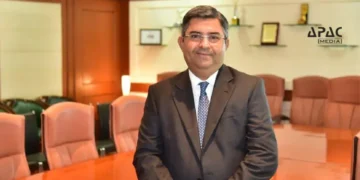





Bengaluru Metropolitan Transport Corporation (BMTC) has been leading the city’s public transport transformation. Ramachandran R, IAS, Managing Director, BMTC, in an exclusive conversation with Bhaswati Guha Majumder, Associate Editor at APAC Media, shares how the corporation is leveraging AI-driven traffic coordination, predictive maintenance and digital ticketing to enhance efficiency and commuter experience, while also focusing on expanding its electric bus fleet, improving accessibility for differently-abled commuters, and strengthening last-mile and metro feeder connectivity.
Bengaluru has deployed AI-driven traffic management systems and adaptive signal control on key corridors. How is BMTC coordinating with the traffic management authorities to ensure bus priority, signal pre-emption and reduced delays for public transport?
BMTC has been collaborating with Bengaluru Traffic Police and the city’s traffic management centre to prioritise public transport on high-density corridors. 65 adaptive traffic signals have already been integrated with bus priority logic, covering corridors such as Outer Ring Road, Hosur Road, and Airport Road.
Average signal delay for BMTC buses on pilot corridors has reduced by 18–22 per cent, improving schedule adherence and reducing travel time by up to 6 minutes per trip during peak hours.
Real-time bus location data from over 6,500 buses is shared with the traffic management system to enable dynamic signal priority.
BMTC has been rapidly expanding its electric-bus fleet, but reports have highlighted both large deliveries and concerns about e-bus reliability and conductor ergonomics. What steps is BMTC taking to improve e-bus uptime, maintenance protocols and driver/conductor safety and do you have targets for fleet availability and mean time between failures?
BMTC operates one of the largest urban e-bus fleets in India with over 1,200 electric buses currently in service and another 1,500 planned by 2026.
Average fleet availability currently stands at 91 per cent, with a target of 95 per cent by next fiscal. MTBF (Mean Time Between Failures) has improved from 1,800 km to 2,600 km over the past year.
Real-time telematics systems and predictive maintenance have cut major breakdown incidents by 27 per cent. Driver and conductor training has covered over 4,000 staff, with an emphasis on ergonomics and safe operations.
BMTC has rolled out smart ticketing system. Could you please explain this further? How far along is the transition to a unified digital payments and ticketing platform and what metrics can you share?
BMTC’s smart ticketing platform is now active on 100 per cent of its fleet, with the Namma BMTC app integrated for passenger convenience. 60 per cent of daily transactions are now digital (QR code, UPI, smart cards, mobile app).
This shift has reduced cash handling by Rs 3.5 crore per month. Daily ridership stands at around 34–35 lakh passengers, and over 10 lakh digital transactions are recorded daily.
BMTC is also working to integrate with a common mobility payment system to enable seamless intermodal travel with metro and suburban rail.
Accessibility initiatives such as the OnBoard system for visually impaired commuters are being piloted. Can you outline the rollout plan, accessibility KPIs, training for staff and how BMTC will measure the impact on the mobility of persons with disabilities?
BMTC’s OnBoard system for visually impaired commuters is being piloted on 20 high-ridership routes. Audio-visual route announcements and tactile markings are being installed at major terminals and in buses. 2,000+ staff (drivers, conductors, depot supervisors) have undergone sensitisation training.
Accessibility KPIs include reduction in boarding time, user satisfaction ratings, and the number of accessible trips completed. The aim is to scale this initiative to 500 routes by 2026, ensuring inclusivity for all commuters.
What is your strategy for partnering with tech firms and research institutions – what areas are you prioritising (data analytics, predictive maintenance, MaaS, last-mile integration) and how do you manage vendor accountability and data governance?
BMTC is leveraging partnerships with leading research institutions and technology firms for:
- Predictive maintenance (reducing breakdowns by 27 per cent).
- Route optimisation through AI analytics, increasing fleet productivity by 8–10 per cent.
- Pilots on Mobility-as-a-Service (MaaS) platforms, with metro and shared mobility integration.
Data governance is managed through structured vendor SLAs and an in-house data command centre that aggregates real-time feeds from buses, ticketing systems, and passenger apps.
With Bengaluru’s population and commuter demand rising, how is BMTC accelerating last-mile solutions, metro feeder services and integrated planning to shift commuters from private vehicles to public transport – and what short- and medium-term targets have you set for modal share and peak-hour capacity?
With Bengaluru’s population exceeding 1.4 crore and peak-hour commuter volumes growing rapidly, BMTC is focusing on last-mile connectivity and intermodal integration.
Over 140 metro feeder services are already operational, with 30 per cent of feeders electrified. Last-mile shuttles and shared e-auto services are being integrated at key metro stations.
Target: increase public transport modal share from 48 per cent to 60 per cent by 2030, in line with the city’s sustainable mobility plan.
Peak-hour passenger capacity is projected to grow from 40 lakh to 55 lakh daily trips through a combination of new e-bus induction, route rationalisation, and technology-led operations.












Discussion about this post