

































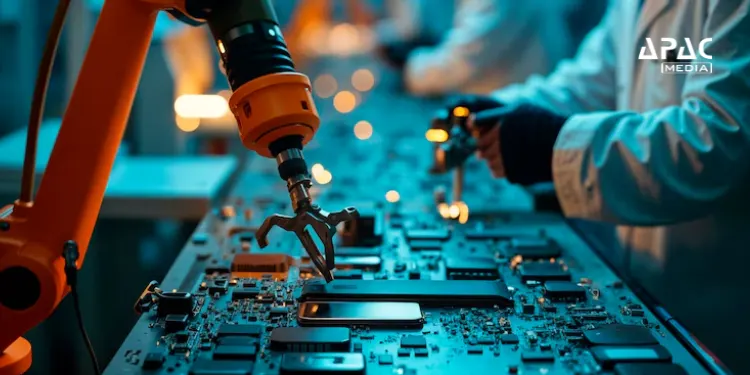
New Delhi: India’s electronics industry has rapidly climbed the ranks of the country’s export economy, emerging as one of the strongest drivers of manufacturing-led growth.
According to the Economic Survey 2026, tabled in Parliament on 29 January, electronics exports have surged from being the seventh-largest export category in FY22 to the third-largest and fastest-growing segment in FY25.
The momentum has carried into the first half of FY26, with electronics exports reaching $22.2 billion, positioning the sector to become India’s second-largest export segment. The Survey attributes this rise to a structural transformation in manufacturing, marked by higher domestic output, a clear export orientation and deeper integration with global value chains.
Mobile phone manufacturing has been at the core of this shift. Production in the segment has expanded nearly 30 times over the past decade, rising from Rs 18,000 crore in FY15 to Rs 5.45 lakh crore in FY25. India has transitioned from a net importer of mobile phones to the world’s second-largest manufacturer, supported by a sharp increase in manufacturing capacity. The number of mobile manufacturing units has grown from just two in 2014 to over 300, reflecting sustained investments across assembly lines, components and supply-chain infrastructure.
Government policy has played a pivotal role in this expansion. The Production-Linked Incentive (PLI) scheme for large-scale electronics manufacturing, launched in 2020, has resulted in cumulative production of Rs 9.34 lakh crore, exports worth Rs 5.12 lakh crore and investments of Rs 13,759 crore as of September 2025. The PLI 2.0 scheme for IT hardware, introduced in 2023, has added production of Rs 14,462.7 crore and investments of Rs 892.47 crore.
To strengthen domestic value addition, the government notified the Rs 22,919 crore Electronics Component Manufacturing Scheme (ECMS) in April 2025, aimed at expanding the component ecosystem through turnover-linked and capital expenditure-based incentives. Infrastructure support has been reinforced through the Electronics Manufacturing Clusters (EMC and EMC 2.0) schemes, under which 30 clusters and five common facility centres have been approved to offer plug-and-play manufacturing facilities.
The component and semiconductor segments have also seen steady progress. Under the Scheme for Promotion of Manufacturing of Electronic Components and Semiconductors (SPECS), 58 proposals involving planned investments of Rs 22,081 crore have been approved, offering financial incentives covering 25 per cent of capital expenditure.















Discussion about this post