










The Bigger Picture
In the wake of India’s rapid economic growth and rise in its position in the Global Economy, it is imperative to provide a robust transport system in the cities and also, covering the surrounding urban agglomeration to cater to the transport needs for overall industrial and other developments taking place in the vicinity. It is therefore given due importance and the need for establishing Metro rail systems for fast and timely mobility. Metro Rail systems provide people a superior travel experience at affordable cost. It would reduce considerable logistic costs and hence designed a long-term plan for its expansion in all larger cities in a phased manner, as provided in the visionary PM Gati Shakti Plan document.

Today, more and more Indian cities having above 2.0 Million population are adopting this most sophisticated mode and model of Urban Transportation. The Metro Rail offers travelling public a fast, safe, comfortable, reliable, pollution- free and affordable public transportation in the midst of fast urbanization.
However, the long-term success of any metro rail system just not depend solely on engineering excellence and such other reasons. Financial sustainability of this massive public investment leas capital- intensive system is important to run the system, for which the organisation should adopt diversified revenue generating measures and implement them in an organised way. The main sources of income includes Fare-Box and Non-Fare Box revenues. Earlier, the revenue estimates assumed were 90% from Fare Box and 10% from NFB. But, of late, the organisations have realised that there is a need to increase NFB revenues around 25%, so as to create a favorable and stable revenue structure.
Financial sustainability and the revenue implications
As said above, the Metro Rail Systems are capital-intensive projects that needs large scale investment by the Governments and it takes comparatively longer time in reaching the breakeven point and for achieving financial sustainability. It is therefore essential for the metro rail organisations to strive hard to achieve higher revenues to make the system financially viable and remain as financially sustainable entity in the long run. Hence, all efforts are to be made to gain sizeable share in the city transport sector. Since Fare Box revenues forms major part of metro earnings among other revenue streams, various steps are to be taken to attract higher ridership.
The capital investment on metro rail projects come from Government equity, loans and external borrowings. During operations’ period also, O&M costs are substantial. As such, to meet the financial costs as well as the operating expenses, the organisations must explore various revenue earning opportunities within the organisational network.
Such revenue streams are—
- Fare revenues
- Rentals on Commercial spaces
- Advertisement incomes
- Parking spaces
- Property Development
- Transit Oriented Development revenues
The organizations should try to exploit every revenue stream for maximization of earnings. However, Fare Box revenue remains the main source of income for metro organizations. It needs maximising the traffic demand/ higher patronage on metro rails is providing an easy access to the metro stations besides time-saving ticketing system, seamless transportation and affordable end-to-end trip cost etc. for which metro organizations need to find and implement suitable solutions
Understanding First & Last mail Connectivity:
One of the critical factors influencing ridership is to provide easy access to the metro stations by creating strong first and last mail connectivity to the city commuters and other travelling public. Last mile connectivity refers to the movement of passengers between a transit station and their end-point of their origin or destination. The destination points are usually the Industrial workplaces, Government offices, Educational institutions, Hospitals and Marketplaces etc. If reaching these destinations are inconvenient, unsafe, time consuming and costly, the commuters are naturally do not show interest in regular travel by metro. Commuters evaluate their journey holistically i.e. from home to destination and back to home.
Impact on Ridership Revenues:
The fare box revenues is the main source of earnings and hence ridership is the lifeline of any metro rail system. Higher ridership ensures better utilisation of infrastructure and justifies the huge capital investment involved. Strong First & Last mile connectivity directly increases the ridership by reducing travel time, making a comfortable and reliable travel experience, less over all travel cost and safety, especially for women and the elderly people, which strengthens financial viability.
Availability of connectivity infrastructure like feeder buses, cabs, shared auto-rickshaws, e- rickshaws, cycle tracks, ride-hailing services, or pedestrian-friendly pathways. If this segment of the journey is inconvenient, costly, unsafe, or time-consuming, commuters often tend to shift back to private vehicles.
The Metro Rail organizations, often face the challenge that even though the metro network has expanded and provides fast intra-city travel, the absence of reliable feeder services, safe footpaths, and affordable short-distance intermediate transport (IPT) discourages regular use of Metro Rail System.
The Way Forward
Having said that the first & last mile connectivity is the key to attract and to constantly maintain higher ridership figures, some practical solutions are suggested that are indicative but not exhaustive:
- Enter MoUs with transport aggregators for providing a seamless transit at an affordable travel cost. Seek cooperation from the local administration and government for smooth and effective implementation.
- Easy accessibility to Stations by developing pedestrian pathways and provide cycles at nominal hiring charges to reach nearby colonies and community centres from metro
- Develop a commuter-friendly Mobile App and share passenger information relevant to metro travel.
- Ticket sales to be extended by installing Ticket Vending machines at and nearby Metro Stations besides ticketing windows and enable purchases through UPI, Debit Card
- Develop a common mobility card by integrating all city transport
- Offer Seasonal concessions, Group concessions to companies, occasional discounts in fares etc. are some of the steps to attract higher ridership.
Best practices followed in cities
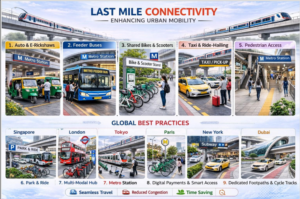
In Hong kong, Metro system is widely spread reaching important office complexes, residential towers, market areas, Bus terminals etc. For most of the residents, metro stations are just in walk able distance.
The Tube railway, the oldest underground metro rail system in UK is connected to every rail, bus, IPT terminals with wide pathways.
In Seoul, the capital city of S. Korea, public cycling system and pedestrian pathways are adequately provided to reach out to the nearby residential/ market areas.
In Indian cities, presently Delhi and Kolkata are having good last mile connectivity. Bangaluru, Kochi, Hyderabad and Chennai are also making efforts to establish strong last mile connectivity facility.
The Urban Transportation Consultants are of the opinion that the achievable transport mode share of metro is maximum 23-25% in Indian cities , where as it is much higher in the international cities. It is however, possible to increase the mode share with the robust First mile and Last mile connectivity.