

























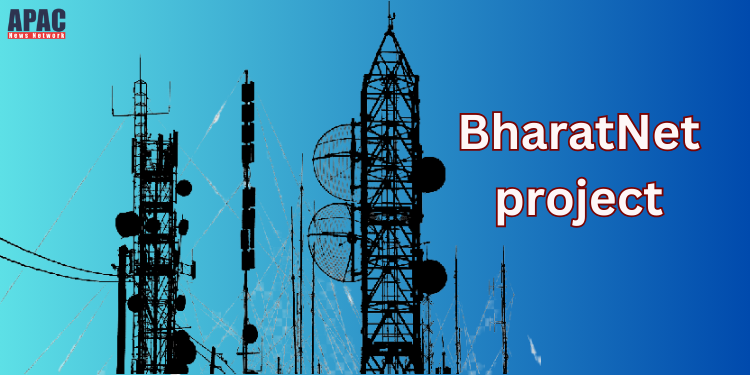
New Delhi: In the revised BharatNet project with a budget of Rs 1.4 trillion, the government is planning to utilise high-speed satellite connectivity technology and fixed wireless access (FWA) in addition to fibre connectivity to connect rural areas.
The objective is to reach 10% of the gram panchayats in remote and mountainous regions where optical fibre cable deployment is challenging. This initiative may open up opportunities for collaboration with companies like Jio, Starlink, and OneWeb.
Furthermore, there is a possibility that BSNL could partner with satellite communication (satcom) providers to offer satellite broadband connectivity.
A government official stated, “We will review the requirements to consider connectivity via low earth orbit (LEO) and medium earth orbit (MEO) satellites. The priority currently is to start the implementation of the revamped BharatNet project.”
In the initial phases of the project (phase 1 and phase 2), some gram panchayats received broadband connectivity through geostationary satellites using services from Hughes. However, experts have pointed out that GEO satellites may not be suitable for applications requiring low latency compared to LEO and MEO constellations.
The decision to incorporate satellite connectivity into the BharatNet project will be dependent on requirements and cost-effectiveness, according to officials.
State-owned BSNL, serving as the single project management agency for BharatNet, is expected to release a tender next month. This tender will be used to select companies responsible for laying out fibre infrastructure and managing sites connected under the BharatNet project. The company aims to issue the tender and commence project implementation in March or April of the following year.
The primary goal is to upgrade the existing 164,000 gram panchayats connected under BharatNet phase I and phase II projects and connect an additional 47,000 gram panchayats under the new model.
The revamped BharatNet project comprises a three-tier architecture: Internet leased line bandwidth provided by BSNL at 7,269 blocks, middle-mile connectivity (from block to gram panchayat) operated and maintained by private players for a 10-year period, and last-mile connectivity (from village to household) through the Udyami model.
To expand connectivity to gram panchayats, the BharatNet network will be further extended to reach and maintain 264,000 gram panchayats through specialised agencies with expertise in optical fibre networks.
Similar to private telecom companies like Airtel and Jio, who engage local cable operators (LCOs) to offer fixed home broadband services, the government, under the revamped BharatNet model, will involve village-level entrepreneurs or Udyamis.
These Udyamis will establish fibre connections to homes on a revenue-sharing basis of 50-50. Additionally, they will receive a one-time financial incentive ranging from Rs 8,900 to Rs 12,900 per fibre-to-the-home (FTTH) connection under the project.
Officials indicate that BSNL aims to provide 15 million home fibre connections over a five-year period using the BharatNet Udyami model.
In August, the Union Cabinet approved a third funding package of Rs 1.39 trillion for BharatNet, bringing the total allocation to over Rs 2 trillion.
The Cabinet had previously allocated Rs 42,068 crore for the BharatNet (Phase-I and Phase-II) projects in 2017 and an additional Rs 19,041 crore in 2021 for implementation under the public-private partnership (PPP) model, which did not attract private sector interest.
As of October 16, the government has made 203,436 gram panchayats service-ready under the BharatNet project. Additionally, a total of 669,012 FTTH connections have been established, and approximately 250,000 villages out of 640,000 have been connected under BharatNet.


Discussion about this post