




















New Delhi: Union Finance Minister Nirmala Sitharaman on 3 September announced sweeping changes in Goods and Services Tax (GST) structure, following a meeting of the 56th GST Council where all state finance ministers were present.
She expressed gratitude for the consensus achieved, saying, “I want to thank every member of the GST council. Every finance minister who attended the GST council today, there was no absence, everyone was present. We’ve had a day of tense discussion but I am grateful to each one of them.” She also highlighted Prime Minister Narendra Modi’s commitment to GST reforms, recalling his mention of next-gen GST in the Independence Day address on 15 August.
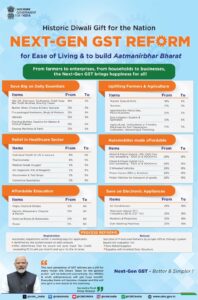
The reforms, described as a historic Diwali gift, are expected to bring significant relief for households, farmers, MSMEs and the middle class. Sitharaman detailed reductions across key sectors:
Daily Essentials & Household Items
GST has been slashed from 18 per cent or 12 per cent to 5 per cent on everyday goods such as hair oil, shampoos, toilet soap bars, toothbrushes, toothpaste, kitchenware, tableware, feeding bottles, clinical diapers and sewing machines. Pre-packaged namkeen, bhujia, mixtures, butter, ghee, cheese and dairy spreads will also now attract just 5 per cent. Ultra-high temperature (UHT) milk, paneer (chena) and Indian breads have been fully exempted, down from 5 per cent to nil.
Electronics & Appliances
GST on air conditioners, TVs above 32 inches (including LED and LCD), monitors, projectors and dishwashing machines has been cut from 28 per cent to 18 per cent.
Automobiles Made Affordable
The automotive sector will see substantial uniformity with a new 18 per cent GST rate. This includes small petrol, LPG and CNG cars (up to 1200cc and 4000mm), diesel cars (up to 1500cc), motorcycles below 350cc, three-wheelers, trucks, buses and ambulances. Auto parts will now uniformly attract 18 per cent.
Healthcare & Insurance
All diagnostic kits, reagents, glucometers, test strips and thermometers will attract 5 per cent GST instead of 12 per cent. Life and health insurance premiums, including family floater and senior citizen policies, are now GST-free. Thirty-eight lifesaving medicines and drugs have been moved to zero tax, while three critical medicines for cancer, rare and chronic diseases also face complete exemption.
Agriculture & Farmers’ Relief
GST on tractors, tractor tyres, parts, drip irrigation systems, sprinklers, and agricultural, horticultural and forestry machines for cultivation, soil preparation, harvesting and threshing has been reduced from 18 per cent/12 per cent to 5 per cent. Twelve specified bio-pesticides also move from 12 per cent to 5 per cent. Fertiliser inputs like sulfuric acid, nitric acid and ammonium have been slashed from 18 per cent to 5 per cent.
Renewable Energy & Labour-Intensive Sectors
Devices like biogas plants, wind turbines, solar panels, solar cookers and solar water heaters will now attract 5 per cent GST, down from 12 per cent. Handicrafts and certain leather products will also see rates reduced to 5 per cent.
Cement Sector
Cement rates have been cut from 28 per cent to 18 per cent, a major boost for infrastructure and real estate.
Special Rates
A higher 40 per cent rate has been reserved for pan masala, cigarettes, gutka and mid-to-large-sized cars.
Sitharaman confirmed that the revised GST rates on all goods, except tobacco-related products, will be implemented from 22 September 2025.