




















Soon the Children’s Park opposite Kanakakkunnu would be given a new look replete with new play equipment, a sparkling pond with water lilies, pathways and illumination. Owned by the Kerala Water Authority, the park is to get a major makeover.

Boundary wall will be redesigned to ensure safety. Entrance gate will be renovated and redefined as a plaza space overlooked by a security cabin. A podium for sculpture will be provided near the entrance plaza. Continuous walkway and park benches would be constructed for better connectivity and barrier free movement. From the entrance plaza, towards right side there will be facilities such as skating yard, food kiosks and open chess court.
Open chess court is an enlarged chess board on the ground with large movable chess pieces. The skating area can also be used for small gatherings like meditation/yoga purposes. Just after the entrance there will be a central plaza with a central strolling path and seating along it.
There will be a dedicated open gym area easily accessible from the entrance plaza which will have equipments such as seated chest press, twist stepper, rider, arm &pedal bike and squat pushing. The current pond in the left side will be rejuvenated and converted to a Lilly pond with seating and proper lighting which will be a quiet zone in the park.
Towards the higher terrain of the park, active play area for kids is proposed. In this area, play equipment will be provided. Unique features like rope bridge and terrain slides will be turning this space into an adventurous zone. There is an area dedicated to toddlers which will be majorly shaded lawn area. This is to create non abrasive injure-free spaces for toddlers.
The project cost of Children’s Park including operation and maintenance for 5 years is Rs.1.92Cr. The project has been awarded to E. Abdul Vahab. Currently the children’s play equipment is broken, pathways are damaged and not connected to all parts of the park, park benches are dilapidated and plants & trees not pruned. The existing water features are the highlight of the park, but it is non-functional/not maintained and bridges over the cascade are not safe. The site itself calls for safety measures being contoured terrain, which is lacking in the current scenario. Proper illumination is very much needed in this site.
All these issues have been adequately addressed in the design proposal and overall development is planned toattract more footfall on daily basis.
ANGANWADIS ARMED WITH BETTER FACILITIES

Being developed at an estimated cost of Rs.0.22 Cr, the anganwadi at Rajaji Nagar is an example of sprucing up a heath facility. The Anganwadi comes under the purview of Integrated Child Development Services (ICDS).
Under the Thiruvananthapuram Municipal Corporation, the Anganwadi was dilapidated and had cracks in the walls, some windows/doors were damaged, storage space were inadequate and paver blocks in the premises were damaged. There was no water connection in toilet and additional fan and light were required. Kitchen area had to be more hygienic since food for the children are regularly being cooked in the Anganwadi itself. The boundary walls need’s fencing to ensure safety and to avoid thefts or vandalism.
The project was awarded to S.Sathikumar on 27th May 2019 and the work was completed by 25th March 2020.
Apart from upgrading the building, procurement of extra items were done as per the requirement suggested by ICDS. Provision of toys designed to improve cognitive development in children are provided. Kitchen utensils, container sets and water purifier required.
Among the developmental activities being taken up include pavement, fencing and repairs to temporary roofs to create safe and shaded play area. The flooring and counter tops are finished with durable materials. New inbuilt storages would let the Anganwadi’s operate in a clutter-free and organized manner. Good quality plumbing and electrical fixtures are provided.
Play equipment is fixed on the sand pits in the premises. The furniture procured for the Anganwadi are foldable/ stackable for the ease of space management. All the other miscellaneous items required in an Anganwadi like safety floor mats, washable quilt, white board & markers, stadiometer, weighing scale etc. were bought and placed. In short, the Anganwadi at Rajaji Nagar has turned into this well-equipped ready to move in smart classroom to welcome its children back. The project even had fund allocated for the shifting and rent arrangements for the functioning of Anganwadi during construction time.
IT equipment’s would be supplied to this anganwadi for integration with newer technology for classroom learning. Procurement of Projector, Projector screen, Laptop, Printer cum Scanner, Music System and CCTV cameras will be done soon. The operational cost for the broadband charges and maintenance of IT items will be taken care by SCTL for first 5 years.
Inauguration of ren ovated Anganwadi at Rajajinagar was done by K Sreekumar, Mayor, Thiruvananthapuram in the presence of Sivakumar, MLA, Adv. Rakhi Ravi Kumar- Deputy Mayor Thiruvananthapuram Corporation, P. Bala Kiran IAS, Chief Executive Officer of SCTL,
MULTI-LEVELPARKING at Thiruvananthapuram

A G+4 storied smart parking system with a built-up area of 6000 Sq.mt for 22 cars and around 400 bike parking space along with EV Charging system is planned For long discussions for a parking lot at Thampanoor Railway Station have been taking place and it is coming to fruition.
The project envisages creation of a G+4 storied smart parking system with a built-up area of 6000 Sq.mt for 22 cars and around 400 bike parking space along with EV Charging system. The building would have 24 X 7 CCTV surveillance to detect & prevent any damage to vehicles, unlawful activities or vandalism.
The entry and exit to the building would be controlled using boom barriers and an entry pass would be issued to the driver. The parking fee would be computed as they exit premise and it can be made using cash or digital modes. TMC can get real time data on the number of vehicles. This project is proposed at Corporation land opposite Thampanoor Railway Station which was used a pay and park facility. The Plot area is 50 Cents and it was used primarily as a 2-wheeler parking as there is less space for maneuvering 4 wheelers within the site.
The parking data indicates that this place has a very demand for 2-wheeler parking (in 8 to 12 hours slot) due to many Government officials who arrive for work from nearby districts of Trivandrum. This will ensure that TMC can avoid any revenue leakages due to mismanagement of the parking areas. The total cost of the project is estimated as Rs. 22.903 Cr. The contract of the project is awarded to M/s. Heather Construction. The tentative date of completion of the project is 30th December 2021.
East Fort as it is also called is in the heart of the city and plays host to several events
This project aims at redeveloping Putharikandam Maidanam (East Fort) – overall area 8.13 acres which is a major landmark and city level gathering space in the heart of Trivandrum. This ground is mostly used for political events, religious congregations, festivals, exhibitions, fairs etc.
The design proposal includes entrance gateway which is being extended to create a grand entry to the maidanam, creation of a jogging track, landscaping, rain shelters at equal intervals, water fountains, a tensile roofing over E K Nayanar Memorial Plaza in order to create a shaded space, an open air seating theatre, renovation of the compound wall, introduction of a theme park, better overall illumination for evening walkers and ICT components like Wi-Fi Hotspot, CCTV, Emergency call box, public information display system.
Public toilets outside the maidanam have already been re-developed using Smart City funds. SCTL is also installing two drinking water kiosks within the maidanam. Anert has proposed to fund and install an electric vehicle charger for the electric rickshaws being operated by SCTL in the parking area outside maidanam.
The estimated project cost for overall development of Putharikhandam Maidanam is Rs. 15.93 Cr. The project is awarded to S B Subramoniam.
People alighting at the Thampanoor Railway station would hardly give a look at the Ponnara Sreedhar Park but that is no longer the case. The rotary park spread over an area of 1240 sq.mt is in for a major makeover with landscaping, shifting the existing statue to a higher pedestal, constructing a stage to conduct meetings, illumination works to improve the aesthetics of the park, an art installation with fountain which will be an upcoming selfie point. Park would have 24 X 7 CCTV surveillance to detect & prevent any damage to the park, unlawful activities or vandalism of any kind.
The work has been awarded to State Agri Horticultural Development Co-operative Society with an amount of Rs. 1.1 Cr. The work commenced on 03rd February 2020.
The foundation stone for two key projects of Thiruvananthapuram Smart City (MLCP at Thambanoor and Ponnara Sreedhar Park) were laid by K Sreekumar, Mayor, Thiruvananthapuram in the presence of Adv. Rakhi Ravi Kumar- Deputy Mayor Thiruvananthapuram Corporation, P Bala Kiran IAS, Chief Executive Officer of SCTL, Shri. Palayam Rajan, Chairperson – Town Planning Standing Committee, M. V Jayalekshmi (Ward Councilor- Thampanoor) and Dr. Sanoop Gopikrishna, General Manager (Operations), SCTL.Temple Tank Renovation comes under the project Heritage Conservation with an aim to create an aesthetically pleasing, functional and clean tank and premises to act as a public gathering space.
This project will also preserve water bodies in the city core area. SCTL received permissions from Devaswom Board to rejuvenate two temple tanks within the city centre namely Puthenchantha Temple Tank and Sreekandeswaram Temple Tank. Puthenchantha Temple Tank is located behind the Puthenchantha BalaSubramaniyaswamy Temple near to Chengalchoola-Housing board Junction, SS kovil road (Thampanoor Ward). The site has immense potential to act as an interaction hub for the local community.
Puthenchantha Temple Tank and its premises is already actively used by the residents of Rajaji Nagar as well as the temple authorities. Though the area is currently not very suitable for public activity, it has great scope for development. The major infrastructure works in the Puthenchantha Temple Tank includes the revival of the adjoining vacant land with landscaping works and cleaning / de-silting of the tank.
The tank and premises would be upgraded with bollard lights and power connection in order to be used during evening hours. An entrance gate will be built and pathway towards the temple tank will be treated with durable materials.
Proper signages will be fixed wherever necessary. Play equipment will be provided in the premises considering children. A mandapam is proposed to house small gatherings/performances. The steps to the tank and separate entries for men and women will be renovated. A security cabin is proposed to ensure better usage of the tank and prevent unauthorized usage of the premises.
The landscaping of vacant land is considered for the project along with the temple tank rejuvenation primarily to help in percolation of storm water for the natural recharge of the tank and secondly to develop it as a public space. The landscape will be majorly medicinal plants. The project cost of temple tank renovation (two locations) is Rs.0.88Cr.
The work of the project is awarded to S Sathikumar. Foundation stone of Puthenchantha Temple Tank Renovation project was laid on 22 August 2020 by K Sreekumar, Mayor, Thiruvananthapuram in the presence of Sivakumar, MLA, Rakhi Ravi Kumar- Deputy Mayor Thiruvananthapuram Corporation, P Bala Kiran IAS, Chief Executive Officer of Smart City Thiruvananthapuram Limited (SCTL), Palayam Rajan, Chairperson – Town Planning Standing Committee, Vanjiyoor Babu, Chairperson, Pushpalatha, Chairperson and Dr. Sanoop Gopikrishna, General Manager (Operations), SCTL.
Tank Renovation project
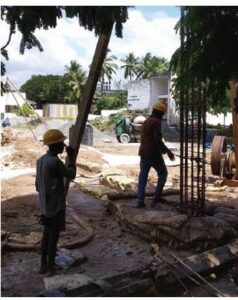
The Sreekanteswaram temple tank rejuvenation project aims to retain the original character of the site by upgrading the physical amenities of the tank environs. The existing Kulappura structure is redesigned as a cultural center and with a dedicated space for Nambi’s daily ritual practices, veda class with library and a community gathering space for the residents around.
The cultural centre is also designed in traditional style. The height of the side walls of the tank will be increased slightly for more safety. Walkways around the tank will be renovated. Since the walkway around the tank is currently not connected, a connecting pedestrian bridge towards the corner of the tank is proposed as a solution.
A continuous walkway around the tank will be constructed, well-lit with traditional fashioned pole lights. The work was awarded to Mr. S Sathikumar for Rs. 52 Lakhs for Sreekanteshwaram Temple Pond.
Foundation stone of Sreek andeswaram Temple Tank Renovation project was laid on 24 August 2020 by Kadakampally Surendran, Minister (Co-op, Tsm. & Dev.) in the presence of K Sree kumar, Mayor, Thiruvananthapuram and presided over by V S Sivakumar, MLA.
Temple Sreekandeswaram The ceremony was conducted in the esteemed presence of Adv. Rakhi Ravi Kumar- Deputy Mayor Thiruvananthapuram Corporation, P. Bala Kiran IAS, Chief Executive Officer of SCTL, N Vasu, President, Thiruvananthapuram Devaswom Board, Dr. B S Thirumeni IAS, Devaswom Commissioner, Palayam Rajan, Chairperson – Town Planning Standing Committee, Vanjiyoor Babu, Chairperson, Development Standing Committee, Pushpalatha, Chairperson, Public Works Standing Committee, G. S Komalavally Ward Councillor (Sreekandeshwaram), SR Sajin, Asst. Devaswom Commissioner, SP Prajit Kumar, Administrative Officer, Sreekandeshwaram Devswom and Dr. Sanoop Gopikrishna, General Manager (Operations), SCTL.
Twvimth goes green e-rickshaws
SCTL has procured 15 E-rickshaws to promote the “shared” electric mobility concept in Thiruvananthapuram. The cost of each vehicle is Rs. 2.30 Lakh and an AIS Compliant GPS is installed in all vehicles as per direction of Motor Vehicle Department. Additional accessories like plastic partition of seats, Rain shield, Rubber mats are also included in these vehicles. Concept of shared mobility is relatively new in Thiruvananthapuram and SCTL aims to promote the same on two routes which witness highest traffic congestions and short distance trips by many commuters. Shared Mobility would mean that the individual passenger has to spend less amount for his travel, whereas the e-rickshaw driver can earn more than the fare rate for a point to point travel (as passengers have varying pickup and drop off points).

Though the mileage obtained on electric rickshaws is considerably higher than a conventional auto, the fare rates would be on par with the rates defined for conventional autos by Transport Department. A Conventional auto would cost Rs. 2.5 to 3 for covering 1 Km whereas the operational cost of an e-rickshaw is around Rs. 0.8 per KM.
The electric vehicle has automated transmission system which makes it easy for anyone to drive it. The driver can charge the vehicles at the comfort of his/her home and it can be operated for around 80 km on a single charge which takes about 2 to 3 hours. The vehicle is powered by a Lithium Ion Battery (which is maintenance free) and it is equipped with a Battery Management System (BMS).
The vehicles will be operated by lady beneficiaries shortlisted by Thiruvananthapuram Corporation, based on applications received. Beneficiaries residing within ABD Area or in nearby wards have been selected for driving e- rickshaws. The vehicles have been purchased in the name of SCTL and it would be transferred to the beneficiary’s names after 1 to 1.5 years of operations. This project is meant to have socio- economic benefits for the citizens and therefore lady beneficiaries under the BPL category without any full-time job have been shortlisted for operating these vehicles.
The real time location of the vehicles can be tracked using the GPS system and the beneficiaries have been advised to navigate through the predefined routes only. Regular checks would be conducted by SCTL officials to avoid any misuse or damage to vehicles. The supplier would give 3 to 5 days of hands on training to the selected beneficiaries.
The electric rickshaws are intended to ferry passengers who undertake short daily trips (especially single passenger trips) to Major landmarks and have to depend on bus or individual autos. These e- rickshaws can carry four passengers at a time on predefined routes. This is meant to supplement the existing public transportation system and reduce the number of single passenger auto trips on the following routes.
Electric rickshaws procured by Smart City Thiruvananthapuram Limited (SCTL) for promoting shared mobility were flagged off by K Sreekumar, Mayor, Thiruvananthapuram in the presence of Adv. Rakhi Ravi Kumar- Deputy Mayor Thiruvananthapuram Corporation, P. Bala Kiran IAS, Chief Executive Officer of SCTL, PalayamRajan, Chairperson-Town Planning Standing Committee, Smt. Pushpalatha, Chairperson – Public works committee and Dr. Sanoop Gopikrishna, General Manager (Operations), SCTL.
Electric autos were flagged off EP Jayarajan, Minister for Industries and sports and the keys of the vehicles were handed over to the beneficiaries by Kadakampally Surendran, Minister for co-operation, Tourism and Devaswoms in the presence of K Sreekumar, Mayor, Thiruvananthapuram Municipal Corporation, K. Ansalan, MLA_Neyattinkara, Adv. Rakhi Ravi Kumar- Deputy Mayor Thiruvananthapuram Municipal Corporation, P. Bala Kiran IAS, Chief Executive Officer of SCTL, Karamana Hari, Chairman- Kerala Automobile Limited, Palayam Rajan, Chairperson- Town Planning Standing Committee, Pushpalatha, Chairperson – Public works committee and Dr. Sanoop Gopikrishna, General Manager.
Clearance of the waste behind Connemara market
Over the years, waste has been dumped and as a result a mountain of waste has piled up behind the existing Connemara market. As part of Palayam Market redevelopment, SCTL has envisaged clearance of the waste dumped and to reclaim 40 cents (1614 Sq. Mt) of valuable urban land. Uncontrolled and continuous dumping of municipal solid waste of Palayam Market and nearby waste has led to piling of mountain of legacy waste.
In 2016, NGT directed CPCB to propose Standard Operating Processing (SOP) for implementation of Bio-mining and Bio-remediation of legacy solid waste. SCTL decided to segregate the accumulated waste into the following six fractions and dispose them scientifically without dumping them in any water bodies or other habitable areas.
The objective is to segregate the accumulated waste into six categories namely; compost manure, incinerable (refuse derived fuel: Plastic products and paper products) – Cement factories, coarse soil, construction and demolition waste, glass and hard plastics and local fractions (like coconut peals) and dispose them scientifically without dumping them in any water body or inhabitable areas.
Initially microbial inoculum would be sprayed over the waste to stabilise the waste. The foul odour would be controlled through spraying of deodorising agents and stabilising the waste using Bio culture for aerobic composting. And then the waste would be segregated into fractions mentioned above and transported to different agencies. The machineries that would be deployed at the site can process 100 tonnes in one 8-hour shift.
Estimates waste is 9624 Cu. Mt of waste and weights around 4842 Tonnes. (Assuming solid waste density as 500 kg/cu.mt) The 40 cents of land thus reclaimed and the 62 cents of vacant land: M Block (Both under TRIDA). Totally, 102 cents of land would be used for construction of rehabilitation block (prefabricated structures) for 500 vendors who would be displaced during the construction activities of Palayam Market.
50 shops under TRIDA would be given permanent shops in the vacant M Block. The work was awarded to M/s MSG Infra for Rs. 91,02,960/-. The reclaimed land would be handed over to SCTL for redevelopment works.
Work on two projects of SCTL was inaugurated by K Sreekumar, Mayor, Thiruvananthapuram and the event was presided over by V S Sivakumar, MLA. Adv. Rakhi Ravi Kumar- Deputy Mayor Thiruvananthapuram Corporation, Jayan Babu, Chairman TRIDA, P. Bala Kiran IAS, Chief Executive Officer of SCTL, Palayam Rajan, Chairperson-Town Planning Standing Committee, Vanjiyoor Babu, Chairperson, Development Standing Committee, Pushpalatha, Chairperson, Public Works Standing Committee, I P Binu, Health Standing Committee Chairman, Aisha Becker, Palayam Councillor and Dr. Sanoop Gopikrishna, General Manager (Operations), SCTL were also present.
Smart fumigation:
In many cases, it can be argued that authorities may be fumigating areas where mosquito density is rather low or may not be fumigating areas often enough where mosquito density is very high and may be fumigating with the wrong type chemical for the mosquito species inhabiting the target area. Authorities plan is to identify the target areas in find smarter ways of doing fumigation.
Smart Mosquito Surveillance System uses state-of-the-art technology to alert health department regarding location, density and type of mosquito population. Empowered with this information, authorities can plan selective fumigation of the areas and then monitor the effect it has had on the mosquito population.
Smart Mosquito Surveillance System eliminates blind spraying of fumigation and thus enables Smart Fumigation. Smart Mosquito Surveillance System consists of a number of Smart Mosquito Sensors (strategically located around the city) and a dashboard would be set up in the integrated command and control centre for public authorities.
25 Smart Mosquito Sensors would be located in most susceptible areas where mosquitoes are likely to breed within Thiruvananthapuram like water bodies, hospitals, markets etc. Areas with high number of reported dengue or malaria cases in recent years, high human population density, poor sanitation would be targeted in the beginning. These sensors capture and identify mosquito types and density. The sensors would report this information over the telecom network to a server on a regular basis.
These sensors use innovative artificial intelligence (AI) algorithms to classify mosquitoes using wing beat, circadian rhythm, height of flight and location parameters. Smart Mosquito Sensors, continuously report (i)type of mosquitos (e.g. malaria, chikunguniya,dengue etc.), (ii) mosquito gender, (iii) density of mosquito population of each type, (iv) temperature and humidity. This can be continuously monitored from the ICCC.
The work was awarded to M/s Trakitnow for anamount of Rs. 53,95,000.