












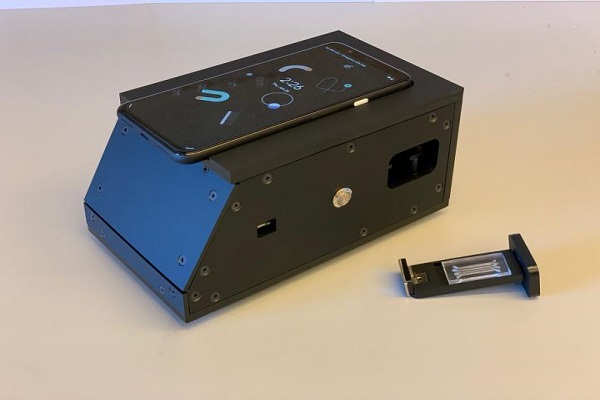
New Delhi: Researchers in the US, including a Nobel laureate, have developed an assay that can detect the presence of coronavirus in a nasal swab using a device attached to an ordinary smartphone. Once rolled out, the smartphone-mounted device will make screening of a large population for the highly contagious coronavirus easier.
The test makes use of CRISPR-Cas technology. Specifically, RNA in the sample can be detected with the Cas13 enzyme, eliminating the need for reverse transcription of the RNA into DNA and then amplification by PCR technology used in current standard tests.
“Our study shows that we can do the detection part of this assay very quickly, making the measurement with mass-produced consumer electronics,” said Daniel Fletcher, a bioengineer at the University of California in Berkeley and co-senior author on the study.
“We don’t need fancy laboratory equipment,” he added, in a paper published in the journal Cell.
Fletcher and co-senior author Melanie Ott (@TheOttLab), a virologist at Gladstone Institutes and the University of California, San Francisco, began collaborating with Nobel laureate Jennifer Doudna, also a co-author on the study, on a rapid, at-home test for HIV.
When Covid-19 hit the scene in January, they quickly pivoted their research to develop a test that would detect the presence of a different virus — SARS-CoV-2.
In the current study, which was primarily designed to be a test of the amplification-free CRISPR-Cas technology and the detector, the nasal swabs were spiked with SARS-CoV-2 RNA.
When Cas13 enzyme binds to the RNA from the virus, it cleaves any surrounding RNA sequences; the researchers added an RNA-based probe to the reaction that gets cleaved and produces fluorescence that can be detected with the camera. The assay provides results within 30 minutes of detection time.
The fluorescence detector consists of a laser to produce illumination and excite the fluorescence and an added lens to help collect light. The phone is placed on top of it. “One takeaway is that the phone camera is ten times better than the plate reader in the lab,” Ott said. “This is directly translatable to it being a better diagnosis reader.”
“PCR is the gold standard, but you have to go through so many steps. There are huge opportunities here for pathogens and for biology in general to make RNA quantification more precise,” the researcher added.
Ultimately, Fletcher and Ott would like to have this type of test be part of a broader system that could be used at home to screen not only for SARS-CoV-2 but other viruses–like those that cause colds and flu.