
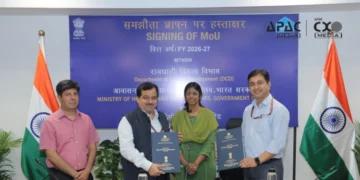





















Bhopal: Amit Sharma, the ADG and Advisor (Cyber) at the Ministry of Defence, Government of India, called attention to the dynamic nature of cloud and cybersecurity during his address at the National Cloud & Cyber Security Summit in Bhopal, organised by APAC News Network, and hosted by the Science and Technology Department, Government of Madhya Pradesh.
Amit Sharma ADG talked on the topic “Changing landscape of Cloud and Cyber Security.” Cloud security, focused on protecting data in cloud computing environments, addresses risks related to data privacy, access controls, and compliance. In parallel, cybersecurity encompasses measures against cyber threats, unauthorised access, and breaches across digital platforms. Sharma stressed the importance of robust security protocols, encryption, access controls, and continuous monitoring to fortify digital infrastructure against cyberattacks.
“The last couple of decades have seen a phenomenal growth in the way in which digitisation has happened. This was further exacerbated in the Covid reign. The key part that worked out was that the classical modes in which we used to operate started changing. We used to work in more physical form, which moved more to the virtual world,” Sharma said.
Sharma acknowledged the transformative impact of the COVID-19 pandemic on digitalisation in India. The pandemic accelerated digitalisation, leading to a surge in remote work, online education, telemedicine, and e-commerce, resulting in increased cybersecurity challenges. “It essentially forced us to move out of our existing stringent thought processes where things were in control to a scenario where we were more cohesive, elaborative and much more intrinsic,” Sharma explained.
India’s status as the largest digital transaction-based country was discussed, highlighting significant growth in digital payments due to government initiatives, increased smartphone penetration, and the push towards a cashless economy. The demonetisation drive in 2016 and the success of UPI played pivotal roles in this transformation.
Amit Sharma ADG also addressed the impact of quantum computing on the BFSI sector and the need for quantum-resistant cryptography to secure digital transactions. “Most of the transactions in the BFSI sector are happening on classic crypto systems. The moment Quantum Computing comes into play, they will be irrelevant,” Sharma said.
Adversarial AI, focusing on defending AI systems against manipulative attacks, was highlighted as crucial in various applications, including cybersecurity, autonomous vehicles, and healthcare.
Sharma gave insights into the Data Protection Bill, emphasising its principles of transparent data use, accountability, and individual rights. The Bill aims to balance personal rights with lawful data use, enhance ease of living and doing business, and promote India’s digital economy and innovation ecosystem.
In his closing remarks, Sharma urged a positive perspective, stating, “Every threat is an opportunity. The only way is how we see those threats, because they emanate out of gaps, and each gap is an opportunity to be filled.”