
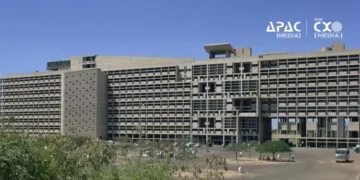
















New Dehi: India’s semiconductor self-reliance journey, which suffered a major setback after a devastating fire at the Semi-conductor Laboratory (SCL), Mohali, in 1989, has regained momentum over the past few years with the emergence of a growing family of indigenous microprocessors.
Prime Minister Narendra Modi once said: “From charkha to chips and ancient Harappan civilisation to modern digital transformation powered by semiconductors, we are heading towards a developed India.”
Now, with the launch of DHRUV64, India has a homegrown 1.0 GHz, 64-bit dual-core processor, strengthening a pipeline that already includes SHAKTI, AJIT, VIKRAM and THEJAS.
Together, these processors reflect a coordinated national effort to reduce dependence on imported chips and build domestic capability in advanced computing.
DHRUV64
DHRUV64 marks a significant milestone in this journey. Developed by the Centre for Development of Advanced Computing (C-DAC) under the Microprocessor Development Programme, it is India’s first indigenous 64-bit dual-core processor operating at 1.0 GHz.
Designed entirely within the country, DHRUV64 is intended to support both strategic and commercial applications, offering India a reliable and modern processor platform for emerging digital needs.
Architecturally, DHRUV64 incorporates modern design features that improve efficiency, multitasking and system reliability. It is built to integrate seamlessly with a wide range of external hardware, making it suitable for sectors such as 5G infrastructure, automotive systems, consumer electronics, industrial automation and the Internet of Things.
Beyond performance, the processor has strategic importance, as it strengthens India’s ability to secure critical digital infrastructure while lowering long-term reliance on foreign microprocessors.
DHRUV64 is also closely linked to the government’s Digital India RISC-V (DIR-V) Programme, which aims to develop a complete portfolio of indigenous processors using open instruction set architectures.
By adopting open architectures, DHRUV64 eliminates licence costs and encourages wider participation from academia, startups and industry.
It is the third processor fabricated under the DIR-V programme, following THEJAS32 and THEJAS64, and its success has accelerated work on the next-generation Dhanush and Dhanush+ processors, which are now under development
SHAKTI
While DHRUV64 represents the latest advance, India’s indigenous processor ecosystem has been evolving over several years. One of the earliest efforts is the SHAKTI processor, led by the RISE group at IIT Madras.
SHAKTI is India’s pioneering open-source processor initiative based on the RISC-V instruction set architecture. Its objective is to foster self-reliance in chip design by offering royalty-free, customizable processors that can be adapted for a wide range of applications, from embedded systems to aerospace.
The SHAKTI programme also seeks to bridge academia and industry while laying the groundwork for indigenous semiconductor solutions at advanced fabrication nodes.
AJIT
Another key milestone is the AJIT processor, India’s first indigenous microprocessor. Designed by researchers at IIT Bombay with funding support from the Ministry of Electronics and Information Technology (MeitY), AJIT is based on the SPARC V8 architecture.
The processor was developed to provide autonomy in electronics and enable applications such as set-top boxes, automation systems and indigenous navigation platforms like NavIC.
AJIT represents an early effort to build secure, low-cost and homegrown microprocessor technology for strategic and civilian use.
VIKRAM
India’s space and defence needs are addressed by the VIKRAM processor, specifically Vikram 3201, developed by ISRO in collaboration with its SCL Chandigarh.
It is India’s first fully indigenous 32-bit microprocessor designed for space missions and critical defence applications. Engineered to operate under extreme temperatures ranging from –55°C to +125°C, VIKRAM marks a significant technological leap from older 16-bit processors used in launch vehicles, reinforcing India’s capabilities in high-reliability electronics.
THEJAS
Complementing these efforts is the THEJAS processor family, developed by C-DAC under the government’s Digital India RISC-V initiative.
THEJAS includes both 32-bit and 64-bit processors and Systems-on-Chip based on the open-source RISC-V architecture.
Designed for applications such as industrial automation, THEJAS processors form a critical part of India’s strategy to establish a scalable and indigenous RISC-V ecosystem.
Taken together, SHAKTI, AJIT, VIKRAM, THEJAS and now DHRUV64 illustrate a clear and deliberate national trajectory. By investing in multiple processor architectures and application domains, India is not only building technical capability but also nurturing talent, research infrastructure and industrial participation.
With DHRUV64 providing a modern, high-performance platform, the country’s indigenous processor ecosystem is moving from experimentation to deployment, marking an important step in India’s long-term semiconductor self-reliance.