














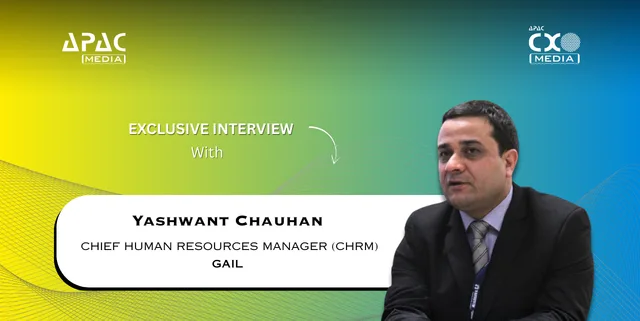
As India’s public sector energy companies expand natural gas infrastructure while navigating the broader energy transition, the role of human resources is undergoing a fundamental shift. In an exclusive interaction with APAC Media, Yashwant Chauhan, Chief Human Resources Manager (CHRM) at GAIL, said HR in PSU energy organisations is moving beyond traditional personnel and administrative functions to become a strategic capability-building partner. He outlined how workforce planning, continuous skilling, safety-focused well-being measures and digital tools are being leveraged to prepare employees for emerging areas such as hydrogen, LNG, renewable energy and digital operations, while aligning human capital strategy with India’s long-term clean energy goals.
Public sector energy companies are expanding natural gas infrastructure alongside a broader energy transition. How is the HR function in the PSU energy sector preparing the workforce for new technologies and evolving skill requirements?
HR Functions in PSU Oil & Gas / Energy Sector Organizations are increasingly shifting from a traditional personnel & administration role to a strategic capability-building role. As natural gas infrastructure expands alongside renewable and low-carbon initiatives, HR Teams are:
- Conducting forward-looking workforce planning to identify future skill gaps across the business value chains.
- Introducing unique roles, and KRA / KPI / Competency-based role frameworks that map existing roles to future technologies.
- Partnering with technology providers, academic institutions, and global Oil & Gas / Energy Sector Organisations to expose employees to emerging practices.
- Encouraging cross-functional mobility so that employees from conventional Oil & Gas / Energy domains can transition into Natural Gas, City Gas Distribution (CNG / PNG), Compressed Bio Gas (CBG), LNG (Liquefied Natural Gas), Hydrogen, Shale Gas, Renewables Energy, Energy Trading, etc.
This ensures continuity while gradually reorienting the workforce toward the overall energy transition.
As large PSUs operate within structured recruitment and promotion frameworks, what reforms or innovations have been introduced in the energy sector to attract young, high-quality talent in an increasingly competitive job market?
Recognising the limitations of traditional recruitment models, many PSU Oil & Gas / Energy Sector Organizations have introduced reforms and innovations such as:
- Specialised recruitment tracks for digital, data science, renewable energy, and sustainability roles, often outside conventional engineering streams.
- Enhanced campus engagement with IITs, NITs, IIMs, and energy-focused institutions (including through internships and live projects).
- Clearer career progression pathways, faster role enrichment, and diversified opportunities for exposure in varied businesses and functions.
- Emphasising the PSU Oil & Gas / Energy Sector Organizations value proposition—job stability, strong social security measures, attractive perks & allowances, nation-building, scale of impact, and long-term learning —while modernising employer branding through digital platforms and social media.
These steps help PSU Oil & Gas / Energy Sector Organizations to attract young, high-quality talent in an increasingly competitive job market.
How are PSUs in the energy sector aligning their training programmes with emerging areas such as hydrogen, LNG and digital operations?
Skilling, Reskilling and Upskilling have become Central to HR Strategy. PSU Oil & Gas / Energy Sector Organizations are aligning their Learning & Development programmes by:
- Establishing dedicated learning & development centres, and skill development institutes
- Leveraging blended learning models—combining classroom sessions, e-learning, simulations, and on-the-job training.
- Collaborating with global technology leaders, forums and multilateral agencies for exposure to international standards and best practices.
- Making training more role-specific and outcome-oriented, rather than generic, to ensure immediate application at the workplace.
The focus is shifting from one-time training to continuous capability development.
What steps are being taken across the PSU energy sector to strengthen occupational safety, mental health support and work-life balance for employees?
Given the high-risk nature of energy operations, PSU Oil & Gas / Energy Sector Organizations are taking a more holistic approach to employee well-being:
- Upgrading occupational safety systems using digital monitoring, artificial intelligence, predictive maintenance, and real-time incident reporting.
- Reinforcing a strong safety culture through behavioural safety programmes and leadership accountability.
- Expanding physical, mental and emotional health support, including counselling services, stress management programmes, and wellbeing awareness initiatives.
- Introducing greater work-life balance measures, such as flexible work arrangements for non-operational roles, leave reforms, and people-centric policies.
Well-being is increasingly seen as integral to productivity and long-term workforce sustainability.
How are public sector energy organisations ensuring that their workforce remains agile and future-ready in the face of rapid technological change and the evolving energy landscape?
To remain agile in a rapidly changing energy landscape, PSU Oil & Gas / Energy Sector Organizations are:
- Moving toward skill & competency-based workforce models, where talent is deployed based on knowledge, skills & competencies rather than rigid job titles.
- Encouraging a culture of continuous learning, development and innovation, including internal idea platforms and innovation challenges.
- Using HR analytics to anticipate attrition risks, skill shortages, and leadership pipeline gaps.
- Preparing future leaders through structured leadership development and succession planning aligned with the future of energy.
Agility is being built through mindset change as much as through systems and processes.
Looking ahead, as India pushes towards cleaner and more sustainable energy goals, how do you see the human resource strategy of PSUs in the energy sector evolving over the next five years?
Over the next five years, HR strategy in PSU Oil & Gas / Energy Sector Organizations is likely to evolve in the following ways:
- Greater focus on green skills, sustainability leadership, and climate-related competencies.
- Increased digitalisation of HR processes, including integration of artificial intelligence in the workflows, from recruitment to performance management and learning & development.
- More flexible and differentiated talent management policies, while remaining within public-sector governance frameworks.
- Stronger emphasis on sense of purpose, employee experience, people-centric policies, diversity and inclusion, especially as younger generations enter the workforce.
- HR is becoming a key enabler of national energy goals, balancing commercial performance with public responsibility.
In essence, HR in PSU Oil & Gas / Energy Sector Organizations will increasingly act as a strategic partner in India’s transition to a cleaner, more resilient, and future-ready energy ecosystem.


Discussion about this post