























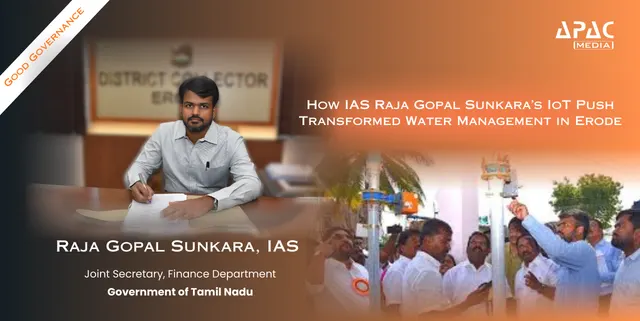
In Tamil Nadu’s Erode district, a technology-led shift changed how villages manage one of their most basic needs: water.
Faced with chronic shortages, high power bills, and manual systems that often failed residents, the district administration turned to Internet of Things (IoT) technology to bring efficiency and predictability to the rural water supply.
The Pioneer

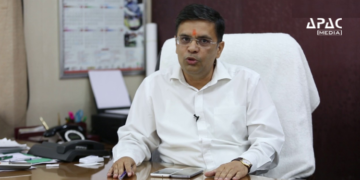
The initiative was led by IAS Raja Gopal Sunkara, former District Collector of Erode, who drew on his prior experience in the water supply sector and his technical background from IIT Kharagpur. Soon after taking charge in May 2023, he identified overhead tanks, or OHTs, as the weakest link in rural water management.
The Problem
Most villages in Erode depended on OHTs fed by borewells or infiltration wells from nearby rivers. These tanks are typically operated manually. The system depended entirely on tank operators being present at the right time. Motors often ran longer than required, tanks overflowed, electricity bills soared, and residents never knew when water would arrive.
Erode’s water demand stands at around 74 million litres per day, but supply has long been inconsistent due to the district’s dry climate and erratic rainfall. Poor monitoring of OHTs only added to the problem, leading to both water wastage and unreliable service.
The Technology-Led Solution

To fix this, the district administration, led by IAS Raja Gopal Sunkara, piloted the use of IoT devices to automate and monitor rural water supply. The first phase covered 50 habitations across 16 villages, with devices installed on overhead tanks to track water levels in real time and control pump operations.
How does the System Work?

The system sends tank-level alerts, automates pumping, prevents overflow, and allows preset water supply schedules. Valves open automatically at fixed times, ensuring predictability. A semi-automatic option remains available for special situations. The devices also collect detailed data on water quantity and supply timings, improving transparency and accountability.
The Impact

The results have been striking. Across the pilot areas, electricity costs have dropped by about 40 percent. Water supply has increased by over 20 percent, even as electricity consumption has fallen by nearly 50 percent in some villages.
In Ponmudi village, one of the early success stories, electricity usage declined by 50 percent after the system was installed. At the same time, daily water availability increased by 44,180 litres. Motors now run only when needed, and overflow has been virtually eliminated.
Beyond Numbers
Reliable water supply also eased daily life, especially for women, who traditionally spent hours waiting near public taps, unsure of when water would flow. Improved pressure and fixed timings reduced uncertainty and saved time.
The Challenges
The rollout was not without hurdles. Early technical issues, including voltage fluctuations that damaged controllers, threatened the project. These were addressed by shifting to solar power with battery backups. Continuous monitoring and close coordination with technology providers helped adapt the system to existing rural infrastructure. Training local representatives and maintenance staff proved critical to keeping the system running smoothly.
The Bigger Picture
The project aligns with national goals under the Atmanirbhar Bharat and Viksit Bharat missions, showing how local innovation and smart use of technology can deliver sustainable outcomes without heavy new spending.
Looking ahead, the district is inviting wider participation. Individuals and companies interested in adopting villages and supporting the expansion of the system are encouraged to come forward.
By turning data into decisions and automation into accountability, Erodethe Eroderict is offering a scalable model for rural India.
What began as a pilot to fix faulty water tanks is fast becoming a national example of how smart technology can secure basic services and improve everyday life!


















Discussion about this post